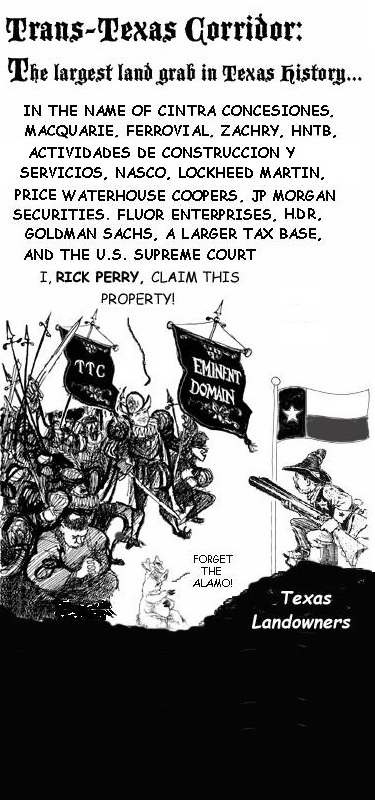
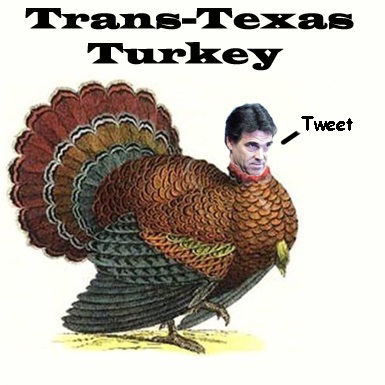
Friday, July 31, 2009
Tuesday, July 14, 2009
$3.2 million in tolls produces $58.4 million in fines for the toll tax bureaucracy
Proposed 'amnesty' would offer forgiveness of most accummulated fees and fines, but scofflaws would have to pay the overdue tolls and get a TxTag.

7/14/09
By Ben Wear
Austin American-Statesman
Copyright 2009
Central Texas toll scofflaws could get a pass on paying much of $56.1 million in late fees and fines under a still-in-the-works "amnesty" policy set for a vote July 30 by the Texas Transportation Commission.
The partial break on the surcharges, which can reach almost $450 per toll, probably would be tied to nonpayers' signing up for a TxTag, the electronic device affixed to windshields that allows a motorist to be charged instantly for tolls. The tardy tolls would still be due in full.
On Monday, Texas Department of Transportation officials were not yet ready to reveal the exact extent of the fine discounts under the amnesty.
Mark Tomlinson, TxDOT's turnpike division director, said that nonpayers would be asked to pay only a "small percentage" of the accumulated fees and fines. Experience with other toll agencies has shown that it takes a substantial reduction to entice violators to come forward, Tomlinson said. And he said the agency already offers nonpayers 50 percent off fees if they pay their tolls in full and sign up for a TxTag.
The amnesty period, which would apply to TxDOT's four Austin tollways and one in Tyler, would last one to two months, officials said.
According to TxDOT, 140,000 "accounts" — individual vehicle owners — have failed to pay $2.1 million in toll charges, for a total of $3.2 million in unpaid tolls. The potential fees and fines associated with those charges, the amount subject to the amnesty: $58.4 million.
Those figures include the Tyler toll road, which has about $60,000 of unpaid tolls and $2.3 million in pending fees and fines.
TxDOT's uncollected money is overwhelmingly from the Central Texas toll roads.
Tomlinson said the agency probably would begin referring some of the cases, those involving chronic nonpayers, to local justice of the peace courts shortly after the amnesty period ends. What about people who might assume that yet another amnesty is down the road and continue to ignore toll bills?
"It would be an absolute mistake for anyone to think in those terms," Tomlinson said. "Our administration has made it absolutely clear that this will be a one-time offer."
The first three of TxDOT's four Austin-area toll roads — Loop 1, Texas 45 North and Texas 130 — opened in November 2006, and the agency began charging motorists in January 2007. The first violators were eligible for referral to court almost two years ago.
TxDOT's other area road, Texas 45 Southeast, which opened this spring, began charging customers only last month and thus would not yet have any violators teed up for a court appearance.
The Central Texas Regional Mobility Authority, which opened Austin's fifth toll road, 183-A, in March 2007, began justice of the peace referrals in January and so far has taken 47 of its worst offenders to court.
Why has it taken so long for TxDOT to begin using the court system for unpaid tolls?
Spokeswoman Karen Amacker said the agency focused initially on its invoicing and collections efforts, which are handled by an outside contractor, the Washington Group, and then on helping the mobility authority begin referring toll cases to court. In addition, she said, TxDOT has to work with several justice of the peace offices — rather than just one, as the mobility authority does — because its 66 miles of Central Texas toll roads extend over a much larger area.
In addition, Tomlinson said, "We've tried to operate with the philosophy of making good toll-paying customers, and we've tried to avoid having to take big violation fees. Certainly, taking people to court is the last resort."
TxDOT's turnpike division has fewer than 40 employees and has seen significant turnover at the top over the past year or so. Tomlinson replaced longtime tollway chief Phil Russell about a year ago at roughly the same time as toll operations director David Powell left for a private sector job. Powell's position has not been filled.
In addition, TxDOT has undergone a tumultuous two years because of a $1.1 billion accounting error and opposition to its use of private toll road leases, creating an inauspicious political environment for taking citizens to court over unpaid tolls.
The fees and fines for a single toll can be substantial. People who go through a tolling point on a TxDOT road without a TxTag or without stopping to pay with cash would get two invoices within 45 days, each carrying a $1 administrative fee. Failure to pay after 75 days raises the fee to $5. Then at day 112 the unpaid toll goes to a collection agency, and the fee jumps to $25.
Going to a justice of the peace court, which would occur at the 200-day mark when TxDOT begins to refer unpaid tolls, could cost a nonpayer almost $450 for each toll.
bwear@statesman.com, 445-3698
© 2009 Austin American-Statesman: www.statesman.com
To search TTC News Archives click
To view the Trans-Texas Corridor Blog click
Monday, July 13, 2009
Senator Hegar: "We didn't get the reforms."

7/13/09
By Heather Menzies
Bay City Tribune
Copyright 2009
The Chamber of Commerce filled a room in the Civic Center Thursday afternoon for a luncheon with featured speaker Sen. Glenn Hegar (R).
Hegar joined the Bay City Chamber of Commerce and Agriculture members Thursday to give his legislative report.
Rep. Randy Weber, Matagorda County Judge Nate McDonald, Bay City Mayor Richard Knapik and many other local officials and business leaders attended the luncheon to hear Hegar's report.
He focused his speech on some of the disappointments of the latest legislative session and included a highlight, especially valuable to Matagorda County residents as well.
Hegar, a farmer and landowner in Katy, said the biggest disappointment from the session was not passing eminent domain reforms. "I will say from this last legislative session, one of my biggest disappointments and something I've worked on for almost four years and that was reforming eminent domain," said Hegar. "When you put that much time and effort into trying to get the land owner a true ability to have a much higher standard of property rights, you work on something for four years now and it doesn't happen - it's really disappointing."
He also spoke about bringing accountability to the Texas Department of Transportation as vice chairman of the Sunset Review Commission. "It's important these agencies go under sunset review," he said.
"With TXDOT it's amazing. They had gotten 100,000 complaints a year from people about road conditions and other issues."
Hegar said one of the main problems is that the department didn't track the complaints. "If I were to ask them what roads in the district are having the most complaints, they would say we have no idea."
According to Hegar, the problems with the department of transportation began at the ones in leadership. "It starts at the top and the problem with that agency is that you had arrogance and arrogance," he said.
"So it's not the men and women out on the streets that are the problem." "And so what we need to get back to is about accountability, transparency and building and maintaining roads." "And so we didn't get the reforms there and that's another reason I was very disappointed in this last session."
Hegar said he was glad that the Texas Windstorm Insurance Association reforms were passed.
"Ike left the windstorm insurance broke and we had to reform that," said Hegar.
"We were fortunate enough to be able to get that accomplished by the end of the last day."
Hegar said he fought to get the surcharges and fees on the TWIA policies taken off.
"I told them to add those on there would be like taking a stick and sticking it in their eye and then taking it out and beating the devil out of them with it," he said.
"You just can't do that to my constituents."
"Ultimately, I think we have something the Texas coast can live by."
He also said he was proud of the fiscally strong budget legislators passed.
"We passed a state budget that will increase less than the cost of living increases and inflation over the next two years," he said.
"Why? Because Texans have to live within their means during this time and government should too."
"So we passed a strong fiscally sound budget."
© 2009 Bay City Tribune: www.baycitytribune.com
To search TTC News Archives click
To view the Trans-Texas Corridor Blog click
Sunday, July 12, 2009
"Local governments and private investors are signing CDA's right up until the [August 31 expiration] deadline."

7/12/09
by Carroll Wilson | Managing Editor
Temple Daily Telegram
Copyright 2009
The Trans-Texas Corridor and its offspring along Interstate 35 are dead, Temple’s state representative said last week.
Ralph Sheffield, a first-term Republican, had just returned from a brief special session called by Gov. Rick Perry specifically to deal with ways to finance the TTC and similar projects.
Powerful opponents have been against the plan ever since it was presented by Perry to cut a 1,200-foot-wide swath up the state’s spine to carry cars, trucks, trains, utilities and oil.
“Especially in rural areas, there’s been a lot of opposition to it,” Sheffield said.
But, Temple Mayor Bill Jones III said it’s ludicrous to believe that Texas can thrive over the next few decades without a massive overhaul of the rail and highway systems.
The state itself declared the TTC dead last January, offering a replacement plan called the Innovative Connectivity in Texas/Vision 2009 program.
The I-35 corridor envisioned in TTC’s scaled-down version would be 600 feet wide and would follow the interstate from the border through the Temple area to Dallas and on up.
While TTC and ICT are both ready for the undertaker, Sheffield said the same might not be true for a corridor planned to follow what would be I-69 from Brownsville through Victoria and Houston and Nacogdoches to the east.
The Legislature killed the I-35-related projects during the two-day session earlier this month. They refused to consider a proposal to extend the life of so-called “comprehensive development agreements” that have allowed for the state to join in private partnerships to raise money to finance highway systems. The state’s authority to use the agreements plays out in August.
Sheffield did not express optimism that the funding mechanism would be approved even during the next regular session, which is two years away.
“Then what is your solution for highways?” Jones asked rhetorically, during an interview. “Texas’ population is projected to double in 35 years, and in the Dallas-Fort Worth-Austin mega-area, it’s projected to go from 16 million to 38 million or 150 percent increase. We’re going to have that kind of growth and not build any highways? That’s ludicrous.”
Jones is an advocate for high-speed rail, particularly the Texas T-Bone, a two-rail system that would link Dallas with Houston and San Antonio and Austin, coming right through Central Texas.
Meanwhile, though, local governments and private investors are signing agreements right up until the deadline. Earlier this month the attorney general of Texas cleared the way for TxDOT and a team of private developers led by Spain-based Cintra’s U.S. office to fund the North Tarrant Express.
Construction could begin next year on the express, which includes new toll and nontoll lanes on Northeast Loop 820, Texas 121/183 and eventually I-35W north of Fort Worth’s downtown, according to a report in the Fort Worth Star-Telegram.
About $570 million in public money is being committed to the $2 billion North Tarrant Express, the Star-Telegram reported. NTE Mobility Partners has agreed to put up $300 million in equity and $1.1 billion in debt in return for the right to build the project and collect tolls on express lanes for 52 years.
© 2009 Temple Daily Telegram: www.tdtnews.com
To search TTC News Archives click
To view the Trans-Texas Corridor Blog click
Saturday, July 11, 2009
"It's up to the taxpayers to remain vigilant...CDAs are the more expensive tool in the toolbox. But that’s the one they keep reaching for."
Bring out your dead [CDAs]!
7/12/09
by Andy Hogue
DallasBlog
Copyright 2009
Two billion dollars and another two years of life isn’t a bad deal for the Texas Department of Transportation, is it? It depends on with whom you speak.
Besides losing the ability to continue transportation comprehensive development agreements (CDAs), the Texas Department of Transportation (TxDOT) and the Perry administration also lost a great deal of political capital and bargaining power after the special legislative session.
The Legislature renewed TxDOT without much in terms of reforms, but did not approve a bill continuing a list of 13 CDAs — effectively calling a time-out on a six-year expansion of toll roads.
This raises a few questions as to where things are going next with transportation.
Surely, $2 billion in recently released Proposition 12 funds won’t last forever in building freeways. So the next two-to-four years are still anyone’s game, and both sides in the toll road debate agree that CDAs aren’t dead — nor is TxDOT giving in. What projects were stopped?
At least two CDA toll projects will be preserved through 2011 under SB 792 from the 80th session — Highway 161 in Dallas and the Grand Parkway loop around Houston. While forging a deal on those projects may continue, most other CDAs will expire Sept. 1.
A lifeline was cast to 13 projects during the special session as part of SB 3, which would have extended their CDAs on a project-by-project basis. There was not enough legislative will to see the whole list through (LSR, July 3), but members attempted to compromise with a short list — only those projects already agreed to by the North Texas Tollway Authority (NTTA), namely managed lanes on I-35 East, Highway 183 and I-30 in the DFW area.
Bill Noble, executive director of the pro-CDA Texans for Safe and Reliable Transportation, said CDAs made Highway 130 bypass around Austin possible, for example. Projects like I-69 were casualties.
There were 87 toll road projects implemented in Texas, per discussion during the 80th legislative session in 2007. According to committee testimony during the 80th interim, about 400 toll projects were being considered. So is it possible that, by the Legislature’s not continuing CDAs, that nearly 300 would-be toll roads were prevented? Terri Hall of Texans United for Reform and Freedom (TURF), a TxDOT watchdog, thinks so (at least for now).
"I do think that they [toll road lobbyists] are going to keep trying to bring CDAs back up, as there’s so much money behind them. So it’s up to the taxpayers to remain vigilant," she said. "CDAs are the more expensive tool in the toolbox. But that’s the one they keep reaching for." Does TxDOT have any clout left?
Hall claims the support of a large movement of taxpayers who oppose the expansion of toll roads and accumulation of debt from CDA agreements. Noble said he’s certain toll roads remain a popular transportation option among voters as a "tool" in the aforementioned toolbox.
"We want all the tools — and that includes gas tax and indexing," Noble said. "But we don’t believe that a massive gas tax would be politically viable, and that’s what would be required if you didn’t have the option of toll roads."
Hall said allowing international conglomerates (such as Cintra of Spain) to own and manage toll roads in private, behind-closed-doors contracts is less politically viable than proposing upping the gas tax.
TxDOT declined to comment.
Rep. Larry Phillips (R-Sherman) thinks there’s plenty of room left for TxDOT to negotiate its future — as well as an extra session in which to debate meaty issues.
"We will need to build roads in the future, and I think that will be the debate over the next two sessions on how we build those roads," Phillips said.
One option to continue CDAs in the future is to give the Legislature oversight over each individual project — a method Phillips said might prove burdensome.
Phillips called for a greater role of toll authorities, such as NTTA and the Harris County Toll Road Authority (HCTRA), in the approval process, as a check on TxDOT.
"Conventional wisdom is that projects may be approved on a case-by-case basis rather than a blanket authority through TxDOT," Noble said. "But that’s a cumbersome process … at the end of the day, Texans are going to realize that roads are not going to get better unless all options are on the table, including toll roads."
Noble said TxDOT’s overall standing has been lowered since mid-decade, but there has been some rebound under the leadership of TTC Chair Deirdre Delisi.
"We did some polling when I first got involved, and back then TxDOT was a highly credible entity. And Texans really had a high opinion — far greater than lawmakers,’" Noble said. "And some of that has come down, especially with leadership. But under the leadership of Delisi and Amadeo Saenz, we’ve seen a sea change — that being, they appreciate the openness, the responsiveness, and the efforts to work with Legislature to find solutions. And you look at it in what the Legislature could have done as far as radical changes in Sunset, all that really didn’t happen."
At least until 2011, TxDOT continues to have a friend in the Governor—most recently exemplified by a veto of HB 2142, which would have prevented TxDOT from advertising the use of toll roads.
"Marketing toll roads as a user-fee-based alternative to congested highways is important to relieving congestion on other state roads and keeping Texas moving," Gov. Rick Perry said in his veto proclamation, echoing TxDOT’s ad campaign slogan "Keep Texas Moving."
U.S. Sen. Kay Bailey Hutchison, likely Perry’s biggest major challenger in the GOP primary for Texas Governor, called for federal legislation to ban tolls on federally owned roadways — a sign that transportation will be a key issue in the 2010 gubernatorial campaign.
Will anti-toll road movements keep on?
Noble said anti-toll-road activists, now that they have their way for at least another two years, are going to have to provide solutions — solutions that may not prove popular with their own volunteers. "The only other way to relieve congestion is a massive gas tax increase," he said. "Opponents of toll roads are slowly beginning to trickle out when faced with the question of ‘what’s your answer?’"
Many conservative opponents of toll roads were leery of Sen. John Carona’s (R-Dallas) solution in the form of the Local Option Transportation Plan – most vocal were concerns that the gas tax would be raised in large communities.
True, a motor fuels tax increase (or index to inflation) won’t be popular with some conservatives, Hall said. But there are more issues at stake in her organization than just the CDAs vs. the gas tax debate, such as transparency in contracts.
"Our legislators often don’t have a clue what’s in these contracts — they have no idea what they’re selling off," Hall said, noting that a Cintra contract for the North Tarrant Express near Fort Worth had a charge of 75 cents per mile at peak hours.
"We’re all in favor of a motor fuels tax increase," she said. "But you have to end [Fund 6] diversions before we give you more money. Also, we’ve got to reform TxDOT — getting into the books, looking into the finances, and basically gutting the agency … Until they change the culture at TxDOT, they will continue to have problems and blowback from the public."
What message was sent by the 81st?
A simple message was sent by the refusal of the Legislature to approve CDAs in the 81st regular and special sessions: CDAs are still highly suspect. Whether or not the Legislature’s inaction on CDAs was a referendum on their viability as a transportation solution is debatable.
"I don’t think the special session was specifically that," Phillips said. "I think that referendum occurred during the regular session on the Sunset bill. And it’s pretty clear that the Legislature wants us to have a transparent process, and that it becomes understandable to the public on how roads are being built … and how MPOs interact with the state, environmental studies are conducted, etc. … It’s fairly difficult in such a short time frame to hash these things out and discuss them [CDAs]. The question was in 2007 can we slow down and take some time in the interim to look at it. So tapping on the brake is not such a bad thing for now."
Noble, who said there has been a "thoroughly inadequate hearing on CDAs" in recent sessions, agreed there is room to haggle. "I think it’s a clean slate for us — we know where we stand now, and for a few years," Noble said.
"I don’t see that CDAs are dead," Phillips said, "as long as we make sure they’re approved by a local community."
© 2009 Dalls Blog: www.dallasblog.com
To search TTC News Archives click
To view the Trans-Texas Corridor Blog click
Thursday, July 09, 2009
"Why does Senator Robert Nichols continue beating the toll road drum? The explanation may lie in his contributor list."

7/9/09
By Roger Gray
KYTX (East Texas)
Copyright 2009
In the last legislative session, the future of toll roads was on the line.
But one area state senator was more involved than most. In fact some critics say the fix was in.
"You can't do toll roads in rural Texas. It won't work," says State Senator Kevin Eltife.
Yes, the original Trans Texas Corridors were huge, and controversial.
Whitehouse rancher and toll road critic Hank Gilbert called it, "the largest land grab in the history of the U.S."
Senator Eltife agreed. "It's a total property right's mess."
Gilbert added, "I don't think the people of Texas, rural and urban, are going to allow that to happen."
And Austin seemed to get the message.
"I think there's no question, the Trans Texas corridor is dead," Eltife concluded.
But some advocates clung to the idea of foreign companies building and running toll roads as private enterprises. Eltife is an opponent. "They should never be owned by a private company, ever. That's a gold mine for the state." As is Gilbert, of Texans United for Reform and Freedom. "Comprehensive Development Agreements that would allow private investors to come in, plan, build, operate, maintain, the whole nine yards."
Eltife agreed, "The state ought to own them. They ought to be a small piece of the puzzle." State Senator Robert Nichols "seemed" to agree when we spoke to him by phone during the session. "The people of East Texas are clear," he said. "They do not want the East Texas Corridor. But they do want to develop Interstate 69."
But did Sen. Nichols want to insure that private toll road contracts were a part of that I-69 development? He added an amendment to his transportation bill that seems to guarantee a contractor couldn't lose money.
Gilbert explained, "You have one of our own East Texas Republican senators is offering an amendment to his own bill which would guarantee a profit. To me that kind of goes against capitalism."
Nichols, though, disagreed. "There is language related to buy backs, but there is absolutely no guarantee whatever that anybody will ever get any of their debt back."
But, we have a copy of an e-mail sent out by toll road lobbyist Gary Bushell, and it says,
"...we have reached an agreement with Senator Nichols on a buyout provision...that provides protection of their position in the event they find themselves upside down on their debt to fair market value...I want to thank Senator Robert Nichols and his chief of staff Steven Albright for making this outcome possible."
Nichols doesn't think that's what he did. "Well, it's incorrect, because that's not true."
Gilbert concluded, "That's not very free market."
So, according to one lobbyist, Senator Robert Nichols went to bat for private toll road contractors.
"That's crazy," he protested. "No. I don't know who told you that, but that's nuts."
I responded, "Well, I've got an email from a lobbyist who says that's exactly what you did."
Nichols again disagreed, "Well, it's incorrect, because that's not true."
"So this lobbyist is wrong," I replied.
"If that's your interpretation of what he says," Nichols responded. "I'm not looking at whatever it is you're reading."
"I read you exactly what he said, " I said. "that provides protection of their position in the event they find themselves upside down on their debt to fair market value.'"
"Ok, I did not write that." He concluded.
Toll road critic Hank Gilbert is skeptical.
"At any point in time, this developer comes to the realization that they're not getting the return on investment they anticipated from this road, they can sell it back to the state at that time and with this amendment, they're guaranteed not to lose money."
Nichols again protested, "If you're saying the State of Texas or any entity is going to guarantee an investor his money back, no. Not correct."
But we have a copy of the amendment and it says.
".the fair market value of the private entity's interest...is not less than the (entity's) outstanding debt at that time plus other reasonable costs."
In short, they get out at least what they've put in.
So why would Nichols continue beating the toll road drum? The explanation may lie in his contributor list.
His top donor by far, James Pitcock of Williams Brothers Construction of Houston, the second largest TxDOT contractor for toll roads and they only gave money to one candidate in 2008, Robert Nichols.
But Nichols still insists toll roads aren't a certainty.
"So, it's your contention that even though these CDA's, comprehensive development agreements are in HB300," I asked, "we're not talking toll roads for East Texas."
"Well, now, that's a different question." He replied. "You have toll roads in Tyler."
And Robert Nichol's tried to push these CDA's again in the special session last week. He didn't succeed.
Apparently, as long as the political money is there, toll road advocates will keep pitching.
© 2009 KYTX: www.cbs19.tv
To search TTC News Archives click
To view the Trans-Texas Corridor Blog click
Monday, July 06, 2009
"It's intriguing how a spotlight can change a politician's perspective...."
During special session, it's safety first for lawmakers.

7/6/09
Ben Wear
Austin American-Statesman
Copyright 2009
It's intriguing how a spotlight can change a politician's perspective. Or in the case of the special session just past, a whole bunch of politicians' perspectives.
Way back in the spring of 2009 (OK, about three months ago), the Texas Senate overwhelmingly passed Senate Bill 404 and Senate Bill 17. The House Transportation Committee later passed both bills. And the Senate even passed them again, this time while they were taking a ride on the Texas Department of Transportation sunset bill that later died.
In fact, all of these bills died in the House late in the session. But it had nothing to do with the content of SB 404 and SB 17, which occasioned little debate during the regular session.
Then, last week, members of the House and Senate turned their noses up at both bills and declined to even vote on them.
To refresh your memory, SB 404 would have extended by several years the authority of TxDOT and regional mobility authorities to sign long-term toll road leases with private companies. Its companion bill, SB 17, would have mandated that such contracts protect the state's and residents' interests by making it easier to build nearby free roads and setting prices now for the state to buy back a private toll road if it ever wanted to.
Those two bills were combined, for the special session, into a single bill. Neither could get a vote in the House Transportation Committee or the Senate Finance Committee. The House Transportation Committee chairman, Joseph Pickett of El Paso, said members did not consider it a "safe vote." Meaning, it was a vote that could turn a legislator into a former legislator.
Remember, this same committee voted for the same changes to the law about seven weeks ago.
Why was it a safe vote in May and a dangerous vote in July?
Back then there were thousands of bills up for consideration, and thus the attention of the public and the press was fragmented. Transportation insiders, anti-toll activists and the few transportation writers for major dailies were paying attention to this. But most people weren't.
Now, with only three subjects on the special session call, and no controversy on two of them, that left the entire focus on this one bill. On legislators voting to allow private toll roads, potentially operated by (and sending profits eventually to) foreign companies like Spanish toll road builder Cintra. On lawmakers in effect undoing a moratorium on most such contracts that they voted for in 2007.
So, why not just bring it up and vote against it? Well, that could then be used against lawmakers later by an opponent saying they'd voted against badly needed roads. And it would be a vote against Gov. Rick Perry, who wanted to extend the authority for private toll roads. A vote against Perry, who has enthusiastically wielded his veto pen through the years.
Of course, presumably somewhere amid all this there is the "right" position to take on this issue — even if what is deemed right might vary from lawmaker to lawmaker — rather than the "safe" position. But Jefferson Smith went to Washington, not Austin.

And he was a fictional character.
For questions, tips or story ideas, contact Getting There at 445-3698 or bwear@statesman.com.
© 2009 Austin American-Statesman: www.statesman.com
To search TTC News Archives click
To view the Trans-Texas Corridor Blog click
Sunday, July 05, 2009
"More than a year after TxDOT was labeled an out-of-control agency in need of reining in...No TxDOT reforms were put into state law."
7/5/09
By Peggy Fikac
San Antonio Express-News
Copyright 2009
AUSTIN — More than a year after the Texas Department of Transportation was labeled an out-of-control agency in need of reining in, lawmakers made their decision: No TxDOT reforms were put into state law.
That means no alteration in the makeup of its governing commission, which is appointed by Gov. Rick Perry and in the past was accused of pushing his ideas without heeding lawmakers leery of such things as privately run toll roads. No special legislative oversight committee. No changes except for those TxDOT carries out on its own.
That's the upshot after a reform bill failed in the regular session and lawmakers meeting in a quickie special session simply continued the agency as is until they reconvene in 2011.
“Certainly I think this is a missed opportunity,” said Rep. Ruth Jones McClendon, D-San Antonio, a House Transportation member who pushed for such changes as an elected commissioner.
The good news: McClendon and some other lawmakers said TxDOT is working to change. Among actions they like is a new contract for a thorough review of agency operations.
TxDOT says it has acted on last year's Sunset Advisory Commission staff recommendations, including an update of its complaint receipt and tracking process. Senate Transportation and Homeland Security Chairman John Carona, R-Dallas, said most Sunset changes are under way.
Among items not addressed is the Transportation Commission makeup. But Carona, who opposes an elected panel as too political, said members are listening to lawmakers' concerns.
McClendon and House Transportation Chairman Joe Pickett, D-El Paso, say there's a need to change the agency “culture.” Pickett said that without a legislative overhaul, “I think they'll try to paint the trim on the ... building, but it's not going to make any real significant difference.”
Lawmakers said even without a new oversight committee, they'll keep close tabs on TxDOT between now and 2011.
“We recognize that TxDOT has been a troubled agency,” Carona said, “and it needs significant attention from the Legislature.”
As some lawmakers fruitlessly urged Perry to add a bill to expand the Children's Health Insurance Program to the special-session agenda, U.S. Sen. Kay Bailey Hutchison's camp still wouldn't say if she supported the measure. Her spokesman, Hans Klingler, said she will be detailing a plan for children's health care and make the issue “a centerpiece” of her expected tough campaign against Perry for the GOP nod for governor.
Perry spokesman Mark Miner said, “Once again, she doesn't have any details to discuss.” He noted Perry's stand that the focus should be on children who already qualify for CHIP but aren't enrolled, adding that Hutchison supported a CHIP expansion in D.C.
Lt. Gov. David Dewhurst, who married Houston lawyer Tricia Bivins just over a week ago, got to spend part of his honeymoon at the Capitol. Session over, he said they plan to go to Colorado or California. His take on his marriage: “Even a blind squirrel sometimes finds a beautiful acorn.”
© 2009 San Antonio Express-News: www.mysanantonio.com
To search TTC News Archives click
To view the Trans-Texas Corridor Blog click
"Perry's Department of Transportation fought like a badger to put state highways 121 and 161 in the hands of private toll road firms."

7/5/09
By MICHAEL A. LINDENBERGER
The Dallas Morning News
Copyright 2009
AUSTIN – Texas spent the past six years leading the nation in its pursuit of private toll roads. Now, it looks to be among the first to call a timeout.
Lawmakers quit the Capitol on Thursday after refusing Gov. Rick Perry's pleas to extend the state's authority to enter long-term contracts with private toll-road developers beyond this summer.
The decision won't kill all private toll roads in Texas – not yet. But it signals a significant halt to one of Perry's signature initiatives, and a pause for a policy that not only helped launch a powerful trend in statehouses across the U.S., but also sparked an explosion of toll roads in Texas, nowhere more extensively than in Dallas.
Perry's policies, first given life by the Legislature in 2003, have meant both billions of dollars in new highways constructed and ever-higher tolls for millions of Texans.
Now, the state may be headed down another road as its authority to strike new deals expires Aug. 31.
"I am as happy as a hog taking a bath in a pond of slop," said Hank Gilbert, an East Texas farmer who was the Democratic – and losing – candidate for agriculture commissioner in 2006. He also has been one of the loudest voices against toll roads in Texas. "It just couldn't be no better than this."
Gilbert and many other grass-roots activists had campaigned tirelessly against toll roads, public or private, since 2003.
The strongest opposition came from voices in rural Texas, where roads are already adequate and where many feared, unnecessarily it turned out, that Perry's proposed Trans Texas Corridor would result in a giant land-grab.
Urban impact
But it is places like Houston, Austin, and, especially, Dallas that have seen the biggest impact of Perry's push. Two of the richest toll contracts in the country involved highways running through North Texas, and Perry's Department of Transportation fought like a badger to put state highways 121 and 161 in the hands of private toll road firms.
Instead, those contracts went to the North Texas Tollway Authority, although the Highway 161 deal is not final.
But in large measure, Perry's approach won there anyway. To beat out private-sector competitors, NTTA had to embrace the same kind of staggering debt loads, quickly escalating toll rates and big upfront payments to the state that characterize the private deals.
The impacts are everywhere in North Texas. Drivers here pay higher toll rates on NTTA's growing network of roads. Rates that were less than 10 cents a mile just a few years ago are about to be 14.5 cents per mile. Rates on so-called managed lane projects, where drivers are given the choice of driving on optional tolled HOV lanes, could be 50 cents to 75 cents a mile, or even more, during rush hour.
Under pressure from local leaders demanding more roads, NTTA plans to build a half-dozen or more major toll roads in the next five to 10 years.
Meanwhile, the Spanish firm Cintra has agreed to spend billions to rebuild LBJ Freeway in Dallas and to construct the North Tarrant Express near Fort Worth. Both projects involve a mix of tax dollars and private funds, and will result in highways with free lanes and tolled managed lanes.
NTTA chairman Paul Wageman said Perry's push for private toll roads has clearly had its benefits but also comes at a price.
"It's not for me to speak to the governor's legacy when it comes to this policy," Wageman said. "But it has allowed the state to build out a network of roads that would not have otherwise been built."
On the other hand, Wageman said, "I do have concerns" that voters don't realize just how many toll roads are headed their way.
"The public needs to be educated and made aware that is what is going to happen," he said.
Some of those toll roads, and others throughout Texas, might end up being private roads despite lawmakers' decision last week.
The Highway 161 project in Dallas County, and the Grand Parkway, a 200-mile tolled loop around Houston, could still be private roads – if the public toll authorities decide they can't build them. A 2007 bill gave state transportation officials until 2011 to conclude private deals on those two projects, and some others throughout Texas.
Kris Heckmann, deputy chief of staff and top transportation expert on Perry's staff, said public toll authorities don't have much time.
"If they don't want it, then they have got to give it to TxDOT in a hurry," Heckmann said, noting that 2011 is not as far away as it seems, given how long some of the private deals can take. "There's still time, but if they screw around for six months there may not be."
Other projects, including the conversion of local HOV lanes to tolled lanes, had been expected to involve private toll road companies, but now can't unless the Legislature restores private toll road authority in 2011.
State has stood out
But whatever the impacts on local roads, one thing is clear, lawmakers have ended, at least temporarily, Texas' role as a national leader in the race among states to embrace privatization.
"Texas was huge," said Leonard Gilroy, an analyst at the Reason Foundation and one of the nation's most insistent voices in favor of privatization of government functions. "They came out with a bold agenda that was combined with a massive need [for new roads]. Other states looked at what was happening and said, 'Wow.' "
The Bush administration championed highway privatization religiously, and praised Texas' push at every turn. But President Barack Obama's secretary of transportation, Ray LaHood, has also embraced it, as have many Democratic leaders in Congress.
New York, Florida, Virginia, Georgia and Pennsylvania all have expanded authority for private toll roads. California, debt-ridden to the point of near-collapse, recently approved new laws that give a green light to Perry-style privatization.
But the legal authority for such projects has often not been followed by new toll roads, at least not to the scale and scope of the leveraged deals in Texas.
Many of the most recent privatization deals involve endeavors other than highways, such as private contracts for city parking in Chicago and Pittsburgh and even, in California, public courthouses.
And increasingly, the existing private toll roads, others note, are confronting the same problems facing NTTA, including sagging traffic and huge debts.
A much-watched deal to sell Chicago's Midway Airport collapsed this spring, and a $12.8 billion proposal to privatize the Pennsylvania Turnpike collapsed last year.
Former U.S. Secretary of Transportation James H. Burnley, who served under President Ronald Reagan and now represents transportation-related clients as a lawyer in Washington, said Wall Street's appetite for the highly leveraged toll road deals has waned.
There is significantly less capital available for those kinds of investments, he said.
"Virtually all of the public-private deals that have been seriously discussed in the past decade have involved significant leverage," he said. "As we return to a more normal economy those kinds of deals will be attractive again. But lenders [may] continue to be more conservative for many years to come, reducing availability of capital for infrastructure."
Because the need for highways is so much more than the available tax funds to pay for it, private toll roads will continue to be important, Burnley said. "But they will play a reduced role."
Break may benefit
Gilroy said a two-year pause in Texas might help strengthen support here for privatization, given that the state's need for new highways isn't going anywhere.
That could make Perry's sales job easier in 2011, when, if re-elected, his aides said he would try to put Texas back on the path to private toll roads.
"Absolutely, the governor is going to keep pushing, pushing for putting this tool back in the box," Heckmann said. "If he had waited for the Legislature to raise taxes or for Congress to send us back an even return on what we send to Washington in gas taxes, then nothing would ever get built."
Gilbert said anti-toll activists are now going to work just as hard to convince lawmakers that a modest increase in gas taxes is politically viable.
Otherwise, Texas will either return to tolls or, just as bad, keep borrowing billions in a race to keep up, he said.
"That is just as fiscally irresponsible as the [private toll roads]," Gilbert said. "The vast majority of Texans would much rather pay at the pump than at the toll booth."
That's not clear. Lawmakers haven't raised the state gas tax since 1991, when they set it at 20 cents per gallon. Congress last increased the federal rate in 1993, to about 18 cents a gallon.
Efforts by Sen. John Carona, R-Dallas, to persuade Texas lawmakers to attach a modest gas tax increase died this past session, just as they did in 2007.
Indeed, probably the most important political dynamic in Perry's push for toll roads lay in the fact that it produced billions in new revenue, without requiring elected officials to raise a single tax. Instead, they simply made it legal to expand tolling, and let it be embraced by local planning boards and toll road authorities themselves, whose members are only indirectly accountable to voters.
Heckmann said that's a good deal for Texans, since "using a toll road is an option."
But as they proliferate, especially in North Texas, and as free roads are allowed to become increasingly traffic-jammed, the notion that toll roads are optional is quickly losing its virtue.
Drivers who use toll roads are paying far more for their highways than they would if they were simply required to pay higher gas taxes. But on the other hand, drivers who don't use them, or use them only rarely, pay much less than they would if gas taxes were increased.
Heckmann said that if lawmakers decide they want to raise gas taxes, then Perry might go along – as long as it was first put to the voters in a constitutional amendment. He said his boss, however, is a political realist.
"We're not holding our breath for that to happen," he said.
WHICH PROJECTS WOULD BE AFFECTED?
Lt. Gov. David Dewhurst, flanked by two leading senators, stressed last week that the decision not to extend the state's authority for private toll roads would not have a negative impact on North Texas drivers. Still, several North Texas projects could be affected. Here's how:
STATE HIGHWAY 161: This Dallas County highway is among a handful of toll roads in Texas that have a special extension from the lawmakers' decision. That means state officials have until 2011 to sign a private toll contract. NTTA has conditionally been awarded the deal but has until February 2010 to sign it. If NTTA passes, the state will have to race to complete a private contract by 2011. Regional transportation officials advanced hundreds of millions of dollars from other projects to speed the highway's construction, and if it is not built as a toll road, they could lose that money.
MANAGED LANE PROJECTS: North Texas' network of HOV lanes has more than doubled in recent years, and scores of miles are slated for conversion to tolled lanes by 2030. Two big projects, the LBJ Freeway reconstruction and North Tarrant Express, will proceed despite lawmakers' decision. Many others won't, or they'll be delayed until at least 2011, when Gov. Rick Perry tries again to get lawmakers to authorize private deals. They include: Interstate 35E from Northwest Dallas to Denton County; I-30 in Dallas and Tarrant counties; and State Highway 183 in Dallas County.
© 2009 The Dallas Morning News: www.dallasnews.com
To search TTC News Archives click
To view the Trans-Texas Corridor Blog click
"Like a pig laying in a cool pool of slop in hundred-degree weather.”

7/5/09
By Josh Baugh
San Antonio Express-News
Copyright 2009
AUSTIN — At the end of the 81st Legislature's special session last week, toll-road opponents went home happy — like “a pig laying in a cool pool of slop,” as one of them put it.
The agency poised to bring toll roads to San Antonio, meanwhile, was left looking toward the 82nd Legislature in 2011, with hopeful expectation that lawmakers then will extend the life of a controversial road-building tool that could pave the way for new toll roads in San Antonio and elsewhere.
In a speedy two-day special session that wrapped up well before dinner Thursday, Texas lawmakers rested on the laurels of two pieces of legislation that extend the life of several state agencies, including the Texas Department of Transportation, and the funding of road projects.
They took the safe road on the hot-button bill that would have extended comprehensive development agreements, or CDAs, letting it die in committee and kicking the issue down the road to a later date — though its proponents vowed to bring it up again at the earliest opportunity.
The controversial measure was vehemently opposed by Texans Uniting for Reform and Freedom, or TURF — a grassroots group that fights toll roads across the state — whose members could scarcely contain their glee.
“Man, we couldn't be any happier,” TURF board member Hank Gilbert said. “I think it's kind of like a pig laying in a cool pool of slop in hundred-degree weather.”
The highly controversial element of CDAs, known as concession contracts, allow private companies to design, build and operate toll roads, and then collect revenue from them for at least the next five decades. The less controversial component of CDAs is the “design-build” agreement, which keeps control of the project with the government agency that built it.
That's a distinction that often gets lost in the vitriolic toll-road debate, and one that Alamo Regional Mobility Authority officials tried to impress on lawmakers during the special session.
Rep. David Leibowitz, D-San Antonio — perhaps TURF's best friend among the Bexar County delegation — said CDAs are nothing more than a way for wealthy private company owners to make even more money. His solution to congestion problems is rooted in the statewide gas tax, which for years has been raided to pay for nontransportation projects. Leibowitz acknowledged the difference between concession contracts and design-build contracts but said the latter is just a “lesser evil.”
But by all accounts, there was no urgency for legislators to take up the issue in the special session because no projects were at risk. There will be building pressure, however, to address CDAs in 2011 because the RMA wants to use design-build contracts to develop the U.S. 281 and Loop 1604 corridors.
By then, Gilbert says, it may be a moot point. In a few months, TURF plans to announce a “more conventional” plan for dealing with congestion problems — one that should receive widespread support from grassroots groups and industry alike, he said. Gilbert wasn't willing to provide further detail.
That aside, lawmakers say they plan to address CDAs in 2011, and Alamo RMA Executive Director Terry Brechtel said she's confident they'll authorize the use of the contracts.
“We have complete confidence that CDA authority will be extended in 2011, specifically the design-build piece that we're interested in,” she said, drawing a nuanced distinction among the contract models that fall under CDAs.
While the bill's failure won't immediately affect any projects in San Antonio, the RMA will push for CDA extension in 2011 because it plans to use design-build contracts to add capacity to U.S. 281 and Loop 1604. By the next Legislature, the RMA will have spent some $18 million on environmental studies for expansion on the two highways. RMA officials say those projects aren't in jeopardy even if CDAs were to die in 2011 because the agency could use traditional low-bid construction contracts rather than design-build contracts.
It's important to note that while the RMA has never ruled out the use of concession agreements, Brechtel said that there's no support to use that form of financing in San Antonio. “Our county judge has not supported concessions. So until our county judge supports concessions, we will not support concessions,” she said. “It's going to take political will to do a private concession in San Antonio, and I don't see the political will.”
© 2009 San Antonio Express-News: www.mysanantonio.com
To search TTC News Archives click
To view the Trans-Texas Corridor Blog click
Friday, July 03, 2009
"This was a back door way to bring back the TTC...I think we killed some really bad legislation.”

7/3/09
From Staff and Wire Reports
Brenham Banner-Press
Copyright 2009
State Rep. Lois Kolkhorst said the just-ended special legislative session was as much a success because of what was not passed as it was for what was.
The Texas Legislature adjourned a two-day special session Thursday, finishing two of the issues assigned to them by Gov. Rick Perry while a measure to allow the state to continue contracting for privately built toll roads never made it out of committee.
Lawmakers passed bills to keep five important state agencies operating for the next two years and a measure authorizing the state to spend $2 billion in bonds to build new roads.
The unanimously approved agency bill will save the Texas Department of Transportation (TxDOT), the Department of Insurance and three other agencies from abolition. That’s because state law requires the Legislature to regularly review and reauthorize state agencies, but lawmakers failed to renew them during the regular session that ended June 1 because of partisan bickering.
Both chambers also passed a bill Thursday that authorizes the state to spend $2 billion in bonds to build new roads. The road bonds were already approved by voters statewide in 2007, but the Legislature still needed to authorize the spending.
House lawmakers added a provision that would prohibit the money from being used to turn existing free roadways into tollways.
The failed measure that would allow the state to continue contracting for privately built toll roads was an upset for Gov. Rick Perry, whose office tried unsuccessfully to broker a compromise in the final hours.
Contracts known as Comprehensive Development Agreements (CDAs) have been used to finance, build and operate toll roads and other projects. But opponents of such contracts worry they take control away from local governments.
Kolkhorst (R-Brenham) said the CDA proposal was another attempt to revive the Trans-Texas Corridor, a network of “superhighways” pushed heavily by Perry.
TTC would have gobbled up vast amounts of land and was bitterly opposed by many rural property owners.
Kolkhorst said there continues to be “a great distrust” for the Texas Transportation Commission and TxDOT.
“There’s a great distrust about the transportation commission, what we’ve been through with the TTC in our area. This was a back door way to bring back the TTC,” she said.
“I’m thrilled that we were able to do that. It’s not so much what you pass but what you kill. And I think we killed some really bad legislation.”
Kolkhorst also applauded a decision to bring back TxDOT back for “sunset review” in two years and approval of the bonding authority.
A proposal to allow half of the $2 billion to be a “revolving loan fund” was not allowed because of concerns private investors would tap into it, then “bundle and sell” the loans again and again.
Kolkhorst said the speed at which the Legislature moved through the special session was also a plus.
“I’m pleased with the way the special session came out. Two days is incredible,” she said. “We saved the taxpayers a lot of money.”
© 2009 Brenham Banner-Press: www.brenhambanner.com
To search TTC News Archives click
To view the Trans-Texas Corridor Blog click
"Rick Perry's interest in the state's growing transportation problems appears to be limited to protecting the contracts of private firms."
Legislature spikes Perry's push for CDAs, transportation revolving fund
7/3/09
By TERRENCE STUTZ and EMILY RAMSHAW
The Dallas Morning News
Copyright 2009
AUSTIN – State lawmakers quickly wrapped up a two-day special session Thursday by approving $2 billion in highway bonds and extending the operations of five agencies – but they spiked Gov. Rick Perry's continued push for toll roads.
Although Perry pressed hard for legislation to allow use of public-private toll roads across the state, both the House and Senate were cool to the idea. And efforts to strike a compromise – including repeated phone calls by the governor and his aides to legislative leaders – fell flat.
"It's time to hit the road," said Sen. Florence Shapiro, R-Plano, expressing relief that the toll-road bill went nowhere during the special session. Shapiro was among several lawmakers from North Texas who disliked the legislation.
Lt. Gov. David Dewhurst and Senate transportation committee chairman John Carona, R-Dallas, said they gave up on the toll-road bill after talking to local transportation agencies around the state. None said the measure – authorizing so-called comprehensive development agreements for toll roads – is needed at the present time.
"We wanted to see if we needed to extend the time eligibility for these agreements, and what we heard from different transportation agencies is 'no,' " Dewhurst said. "We didn't see any urgency for it."
Carona emphasized that the decision to take no action will not have any effect on highway improvements over the next two years.
"No major project is gong to be left behind between now and 2011," he said. "We'll have ample opportunity to take up this issue again in the 2011 session."
The governor also suffered setback in the transportation bonding bill passed by the House and Senate, which decided against placing bond revenue in a revolving fund that could have been used for a wide variety of projects – including privately operated toll roads. Instead, the money will go into a much more restrictive account and cannot be used to convert free roads into toll roads under a House amendment accepted by the Senate.
Perry thanked lawmakers for their work on the highway bond and state agencies bills but voiced regret over inaction on the toll-road proposal.
"I had hoped to reduce uncertainty regarding several major transportation projects across the state by extending the comprehensive development agreement authority for local and state transportation agencies," he said, understating how hard he pushed for passage of the measure.
"Although the CDA bill did not pass, we will continue to work with legislators and local officials to find transportation solutions."
Both the $2 billion bond program and the bill extending the operations of five state agencies easily passed the House and Senate. Those agencies – the transportation and insurance departments, the Office of Public Insurance Counsel, the racing commission and affordable housing corporation – were authorized for another two years but will be scrutinized by lawmakers in their 2011 session.
The transportation bonds bill took a little wrangling to pass in the House, where members tacked on a handful of amendments to head off the possibility of the funds being used for toll roads. Lawmakers also agreed to allow road-building entities such as the North Texas Tollway Authority to stretch out their financing, as opposed to raising rates.
Opposition to the toll roads bill was strongest in the House. Many lawmakers said they're simply turned off by toll roads altogether. Others said it wasn't possible to vet such a divisive issue in a three-day legislative session.
The bill would have reauthorized the kinds of deals that are proliferating in North Texas, including the LBJ Freeway reconstruction, the North Tarrant Express and the DFW Connector. Without it, projects already in the works won't be affected.
But it could delay, or even derail, toll road projects still in the pipeline, such as State Highway 161 in Dallas County.
A spokesman for gubernatorial hopeful Sen. Kay Bailey Hutchison accused Perry of using the special session to line the pockets of corporate toll-road operators, and to pursue the Trans Texas Corridor under a different name.
"Rick Perry's interest in the state's growing transportation problems appears to be limited to protecting the contracts of private firms," Hans Klingler said. "The Trans Texas Corridor and the tolling of roads has been an expensive and expansive assault on the rights of property owners."
A spokesman for Perry fired back at the Hutchison camp.
"Governor Perry will continue to utilize all available resources to address the transportation needs of Texas," Mark Miner said. "Senator Hutchison has been in Washington for 16 years, and Texas continues to be short-changed, receiving only 74 cents back for every tax dollar sent to Washington for roads."
Both Dewhurst and House Speaker Joe Straus said they were delighted to finish up in such a short time.
"Members of the House wanted to pass the bare necessities. They weren't looking to delve very far into substantive policy issues," Straus said, explaining the lack of support for the toll-road bill.
The speaker also said Perry didn't put any pressure on him to steamroll the measure through.
"There were no uneasy conversations about it at all," Straus said. "I don't think there was an urgency."
Several lawmakers questioned Perry's decision to include the toll-road bill on the agenda for the special session, but they also said he deserved credit for not introducing volatile issues that could have forced the session into a partisan standoff, such as the GOP-backed voter ID legislation that was responsible for killing hundreds of non-related bills during the regular session.
© 2009 Dallas Morning News: www.dallasnews.com
To search TTC News Archives click
To view the Trans-Texas Corridor Blog click
Thursday, July 02, 2009
"We defeated a sold out Senate and the BIG MONEY, the lobbyists, who sank millions into pushing for the sale of Texas highways."
CDAs die, pensions protected

7/2/09
Terri Hall
Texans Uniting for Reform and Freedom
Copyright 2009
(Austin, TX) Today, ordinary Texans brought Governor Rick Perry’s road privatization, toll road, and Trans Texas Corridor agenda to a screeching halt.
The Legislature adjourned without re-authorizing private toll road contracts called Comprehensive Development Agreements (or CDAs).
The grassroots scored another victory by KILLING the revolving fund in HB 1, preventing the $2 billion in bonds from being spent to build toll roads, convert freeways to toll roads, or subsidize private toll deals, as well as protecting public employee pension funds from risky toll roads schemes that are failing all over the world.
“It is a hard-fought victory for the grassroots. We killed Goliath, not just Perry’s controversial toll road policies, but we defeated a sold out Senate and the BIG MONEY, the lobbyists, who sank millions into pushing for the sale of Texas highways,” Hank Gilbert, Texas TURF Board member and President of Piney Woods Subregional Planning Commission.
“We applaud Rep. David Leibowitz, once again, for standing up for Texas taxpayers and leading the charge to fix the bill that created a revolving fund that would have raided teacher retirement and public employee pension funds for risky toll road schemes. He authored the bill to KILL the Trans Texas Corridor and another to prevent the conversion of freeways to tollways during the regular session. He’s a proven taxpayer hero and Texans owe him a tremendous debt of gratitude,” said TURF Founder, Terri Hall.
“However, no session is without a few villains. CDA proponents and senate leaders like John Carona and Steve Ogden need to be taken to the woodshed for promising to promote the MOST expensive method of road funding, CDAs, next session, and for wanting to continue to raid public pension funds over the LOUD objections of Texans. None of this is dead in their minds, just postponed until they can resurrect this controversial public fleecing for another day,” Hall emphasized.
Taxpayers wanted Perry’s controversial and virtually universally detested road privatization schemes to die a natural death August 31 as scheduled, which will also KILL the mechanism to build the Trans Texas Corridor (or TTC). Today, they achieved just that.
However, TTC-69/I-69 was excepted out of the moratorium, SB 792, in 2007, so TxDOT has the authority to enter into CDAs for that project through 2011. TURF, in cooperation with two private property rights foundations (Stewards of the Range and American Land Foundation) and local governments, have been instrumental in forming subregional planning commissions in the path of TTC-69, and plan to use these commissions to challenge the TTC and keep it from ever being built.
© 2009 Texans Uniting for Reform and Freedom: www.texasturf.org
To search TTC News Archives click
To view the Trans-Texas Corridor Blog click
Carona: "We will take this (issue) up in 2011.”

7/2/09
By Mike Ward
Austin American-Statesman
Copyright 2009
Lt. Gov. David Dewhurst and Senate leaders just announced publicly what senators had confirmed an hour ago: A bill to continue to allow more privately built toll roads to be constructed is dead in the special legislative session.
And lawmakers plan to finish their other business — approving the issuance of $2 billion in road-building bonds and continuing the operations of five state agencies — and then go home later today.
Dewhurst said attempts for a compromise on the toll-road bills — Senate Bill 3 and House Bill 3 — failed amid growing questions about whether any action on the matter was needed before the Legislature convenes in regular session again in January 2011.
State Sen. John Carona, R-Dallas, chairman of the Senate Transportation and Homeland Security Committee, said the urgency of the matter waned after local and state transportation assured legislative leaders that no projects would be killed or delayed by the lack of a vote.
“If it was a critical issue, we’re here to deal with it,” Corona said. “But we have been assured … that no major project is going to be left behind … We will take this (issue) up in 2011.”
Gov. Rick Perry had called lawmakers back into special session to address three issues: The bonds, to continue the operations of the five agencies that otherwise would have shut down, and to give the authority of the Texas Department of Transportation continued authority to contract for the privately built toll roads — through deals called “comprehensive development agreements.”
Dewhurst said Perry’s reaction to let the third issue on the agenda die without action was: “roads need to get built.”
“They will,” Corona said. “It would be a mistake to do away with CDAs. But we need to take some time to look at this issue, and we can do that in 2011 without any impact on projects.”
So with the controversial issue off the table, here’s what the schedule for the rest of the special session looks like:
At 3:30 p.m., the Senate Finance Committee is expected to approve House Bill 1 (bonds). It will then go to the full Senate for a vote, probably about 5 p.m.
The House earlier today approved Senate Bill 2 (continuation of the agencies, also called the safety-net bill).
Adjournment of both the Senate and the House is expected by early this evening.
© 2009 Austin American-Statesman: www.statesman.com
To search TTC News Archives click
To view the Trans-Texas Corridor Blog click
Lawmakers were "flooded with constituent e-mail opposed to the CDAs."
7/2/09
By APRIL CASTRO
Associated Press Writer
Copyright 2009
AUSTIN, Texas — Two of the issues assigned to the Legislature by Gov. Rick Perry were on the fast track to becoming law Thursday while the third, a measure that would allow the state to continue contracting for privately built toll roads, appeared dead.
"Two out of three ain't bad," said Sen. Craig Estes, R-Wichita Falls, as lawmakers speculated that the special session that convened Wednesday would be adjourned by the end of the day Thursday.
The House and Senate have finished their work on a bill to keep five important state agencies operating for the next two years. After tying up some technical loose ends, the bill next heads to Perry for his signature.
The unanimously approved bill will save the Texas Department of Transportation, the Department of Insurance and three other agencies from abolition. That's because state law requires the Legislature to regularly review and reauthorize state agencies, but lawmakers failed to renew them during the regular session that ended June 1 because of partisan bickering.
Perry called the special session to deal with that and two other transportation bills. State leaders have remained committed to finishing before the holiday weekend, even though special sessions can last up to 30 days.
The House also passed a bill Thursday that authorizes the state to spend $2 billion in bonds to build new roads. The road bonds were already approved by voters statewide in 2007, but the Legislature still needed to authorize the spending.
House lawmakers added a provision that would prohibit the money from being used to turn existing free roadways into tollways. That bill was expected to get approval in the Senate later Thursday.
The measure that would allow the state to continue contracting for privately built toll roads was on the chopping block.
Contracts known as Comprehensive Development Agreements have been used to finance, build and operate toll roads and other projects. But opponents of such contracts worry they take control away from local governments.
Perry and his staff met with lawmakers in an attempt to revive the bill, but with no luck, Lt. Gov. David Dewhurst said.
Rep. Phil King, a Weatherford Republican, said he and others have been flooded with constituent e-mail opposed to the CDAs.
Sen. John Carona, chairman of Senate Transportation and Homeland Security Committee, says CDAs can be looked at again in 2011.
"No major project is going to be left behind between now and 2011," he said.
Associated Press Writer Jim Vertuno contributed to this report.
The bills are HB 1, SB 2 and SB 3.
© 2009 Th Associated Press: www.ap.org
To search TTC News Archives click
To view the Trans-Texas Corridor Blog click
"Sometimes the writing is on the wall, and I'm just not confident we have the support."
Road bond, sunset bills nearing quick passage
But private toll road bill appears to lack support.
7/2/09
By Ben Wear , Mike Ward
Austin American-Statesman
Copyright 2009
Legislators, many of them tanned and exhibiting a relaxed, schools-out air Wednesday, ripped quickly through two of the three issues that Gov. Rick Perry put on their special session plate.
Leaders were predicting final passage by this afternoon of a bill that would keep alive for two more years several state agencies, including the Texas Department of Transportation, and of a second piece of legislation allowing the state to issue $2 billion in transportation bonds.
However, prospects appear dim for a third bill that would extend authority for private companies to finance, build and profit from tollways on government land. The bill, which would put legislators in the uncomfortable position of making a clear, stand-alone vote in favor of private toll roads, was left pending in committees in the House and the Senate.
Although some legislative leaders strove to paint the bill as still breathing late in the day, the chairmen of both committees said flatly that a majority of lawmakers are not on board.
"This issue is controversial, and right now we don't have the votes," said Sen. Steve Ogden, R-Bryan, Senate Finance Committee chairman. "I think we pass the bills that are essential — (Senate Bill) 1 and (Senate Bill) 2. (Senate Bill) 3 is optional."
"Sometimes the writing is on the wall, and I'm just not confident we have the support," said House Transportation Committee chairman Rep. Joseph Pickett, D-El Paso. "Do members understand it? What is a safe vote for the members? For a lot of them, a safe vote is 'no.' "
Pickett said the legislation might have a chance if lawmakers were to hang around for most of the 30 days allowed for a special session. But most legislators appear eager to return to their regularly scheduled summer as soon as possible.
Lt. Gov. David Dewhurst, who presides over the Senate, put out mixed signals late in the day about the private toll road bill. He told reporters minutes after the Senate adjourned for the day at midafternoon that a deal is in the works to continue approval for a limited number of private toll road projects.
Three or four such projects in the Dallas-Fort Worth area are at an advanced stage of development, officials said, and could proceed during the next year or so if the Legislature were to extend authority for such contracts beyond the Sept. 1 expiration date in current law.
Dewhurst said he was about to meet with House Speaker Joe Straus to discuss all three issues Perry put on the special session agenda, known as the "call." Under the Texas Constitution, only the governor can call a special session, and only he can set its agenda.
But Dewhurst, asked after his meeting with Straus about the private toll road issue, said that he and the House speaker had discussed only the scheduling of how to complete action on the transportation bond and agency sunset issues.
All three items on Perry's call for the special session are unfinished business KO'd late in the regular, 140-day session when House Democrats, trying to kill a Republican-backed voter identification bill, stalled action for five days.
Senate Bill 2, passed by the Senate and, as House Bill 2, also approved by a House committee Wednesday, would keep TxDOT, the Texas Department of Insurance, the Texas Racing Commission and several smaller agencies from ceasing to exist under the Texas sunset law.It requires state agencies to undergo an intense review every dozen years; they can continue operating only if the Legislature votes to do so.
Several sunset bills, in the case of TxDOT running to several hundreds of pages after other bills were attached to it, died late in the regular session. A "safety net" sunset bill similar to one now before the Legislature also died in the regular session's final minutes.
Without some sort of action now, those agencies would disappear in September 2010.
The transportation bond legislation, which had widespread support in the regular session, had taken a ride on the TxDOT sunset bill and thus died along with it.
Voters in 2007 had authorized TxDOT to issue up to $5 billion in bonds that would be paid back with general state revenue, rather than gasoline taxes. This legislation would allow the state to borrow the first $2 billion and use half of it to set up a "revolving" fund to loan money to local governments for transportation projects.
TxDOT would spend the other $1 billion, an infusion of cash that has become more critical as available money from both the state and federal gas tax ebbs.
As for private toll roads, a bill extending that authority for four more years passed the full Senate and a House committee during the session, as did a companion bill setting contractual limits designed to protect the state's financial interest. The bill now under consideration, and under siege, is a combination of those two bills.
For supporters of such contracts, which were touted earlier this decade as a way to bring in large upfront payments to TxDOT from private companies, the issue is not so much the next two years. Rather, if the existing authority in state law expires, reviving it may be politically impossible.
"It means the potential loss of billions of dollars for road construction," said former state Rep. Mike Krusee, a Williamson County Republican who carried the original 2003 legislation making such contracts possible. "If the economy were strong, and there's plenty of jobs around, and no congestion, that might be OK. But that's not the case."
bwear@statesman.com, 445-3698
© 2009 Austin American-Statesman: www.statesman.com
To search TTC News Archives click
To view the Trans-Texas Corridor Blog click
"Every landowner and taxpayer in Texas will be responsible for the ‘bailout’ of Perry's AIG (arrogance, ignorance and greed)."
as it contemplates the largest tax increase in Texas history, the sale of Texas to foreign corporations

"Bailouts for Perry's AIG (Arrogance Ignorance and Greed)"
Terri Hall
Texans Uniting for Reform and Freedom
Copyright 2009
(Austin, TX – July 1, 2009) Today, concerned citizens of Texas challenged the Legislature to stand-up to Governor Perry’s road privatization, toll road, and Trans Texas Corridor agenda in a press conference on the South Capitol steps in Austin. Texans demanded the Legislature not just roll over and play dead for Perry's agenda while the leadership of both chambers ram through three bills that will affect Texans for generations.
Concerned citizens are hopping mad about lawmakers’ suspending the rules that are in place to protect the public from a railroad job, and rushing to get home for the 4th of July holiday rather than give due consideration to what some have dubbed the largest tax increase in Texas history, selling Texas highways to PRIVATE foreign corporations. Such a deal inked in North Texas will charge 75 cents PER MILE, or $13 a DAY (like the deal just signed for the North Tarrant Express to privatize I-820) in new toll taxes, for Texans to access PUBLIC roads.
Taxpayers want Perry’s controversial and virtually universally detested road privatization schemes to die a natural death August 31 as scheduled, which will also KILL the mechanism to build the Trans Texas Corridor. Today, it appeared the citizen outcry over the bill, HB 3, to re-authorize such private toll road contracts called Comprehensive Development Agreements (or CDAs) was dead on arrival in the House.
“Texans cannot stomach any more of Gov. Perry's version of AIG (arrogance, ignorance and greed)! His continued insistence to force privatized toll roads down the throats of working Texans is fiscally irresponsible and morally wrong,” insisted Hank Gilbert, Texas TURF Board member and President of Piney Woods Subregional Planning Commission.
“With these types of projects failing all over the United States, as well as Texas (SH 121), every landowner and taxpayer in Texas will be responsible for the ‘bailout’ of Perry's AIG. Add to that, the possibility of investing state employee and teachers retirement funds into these road projects, with his proposed ‘Texas Revolving Fund,’ and you have a Governor that has lost all respect for the people of Texas!
“The elected members of the Texas House and Senate need to do what the public elected them to do…Just Say No! If they don't, then it may very well be the last bad decision that they are allowed to make for the citizens of the great state of Texas!” said Gilbert.
Public subsidies for private profits
CDAS are half-century long sweetheart deals that also suck-up virtually ALL available gas taxes and other highway funds to prop-up toll projects that aren't even toll viable (can't work without subsidizing them). Read about the deals in North Texas that use $1 billion dollars of Texans' gas taxes and public funds, yet motorists won't be able to use the roads without paying $13 a DAY in homage to Spain here.
TURF argues that proponents tell us the private operators are bringing all the money to the table so it's okay to sell-out the taxpayers in sweetheart deals (like non-compete agreements that prohibit ANY new lanes or NEW roads from being built that would "compete" with the private operators toll cash cow as a way to GUARANTEE congestion on free roads). But the FACT is our GAS TAXES and other PUBLIC money are going into these deals, in some cases more public cash than private, then the foreign toll operator charges motorists a DOUBLE TAX to access PUBLIC roads. CDAs also mean massive multi-generational DEBT!
"These public subsidies for private profits are the centerpiece of Rick Perry's special session, yet he claims to be a 'conservative' whose ranks opposed the federal bailout bill that socialized the losses (of private industries) and privatized the profits. There's a name for Perry's actions - hypocrisy," notes TURF Founder, Terri Hall.
Toll authority to raise toll rates 32% because BURIED in debt it can't repay
Read about it here.
Concerned citizens see this as an ALL-OUT ASSAULT on our freedom to travel!
For more info on how just how bad these private toll contracts are for the taxpayers, read more here.
SB 1 to raid public employee pension funds & teacher retirement fund
In another bill for the special session, SB 1, lawmakers resurrect Sen. John Carona's SB 1350 that will set-up a Transportation Bank as a private corporation (controlled by the Governor's political appointees, the Texas Transportation Commission) in order to raid teacher retirement funds and public employee pension funds to invest in these risky toll road schemes that are failing all over the country.
"The revolving fund could provide a vehicle for the Texas Retirement System and Employee Retirement System to invest in state infrastructure, a policy (Sen. Steve) Ogden supports." - Texas Monthly, April 28, 2009
This idea is designed to set-up a "Revolving Fund" to finance toll projects they can't find private investors to bankroll. TURF said it’s the duty of our lawmakers to protect the integrity of public employee retirement funds.
In addition, the Revolving Fund only contributes to the gas tax diversion problem since it will divert MORE gas taxes to toll roads (gas tax can be deposited into the Revolving Fund and recycled to fund toll roads that aren't viable/100% self-sustaining).
Connecting the dots...
Perry, Dewhurst backroom deal to raid funds.
Texas Monthly calls raiding pension funds "irresponsible" and "immoral" here.
© 2009 Texans Uniting for Reform and Freedom: www.texasturf.org
To search TTC News Archives click
To view the Trans-Texas Corridor Blog click
"We are being asked to pass legislation based more on faith than fact."

7/2/09
By EMILY RAMSHAW and TERRENCE STUTZ
The Dallas Morning News
Copyright 2009
AUSTIN – Gov. Rick Perry's special session effort to win new approval for public-private toll roads in Texas may be hitting the skids.
Lawmakers on the House Transportation and Senate Finance committees left the bill pending, saying either they couldn't support it or that it was too complex to vet by the end of the week. That's when top state officials have asked them to wrap up their work.
"I don't know that the support is there," said Democratic Rep. Joe Pickett, who chairs the House Transportation Committee and filed the public-private toll road bill in that chamber.
Added Republican Sen. Steve Ogden, chair of the Senate Finance Committee, "We are being asked to pass legislation based more on faith than fact."
Meanwhile, other members expressed reservations about whether the toll-road bill was necessary and suggested that, despite Perry's call, they might finish the special session without it.
"Why this was put on the call of the special session, I don't know," Sen. Florence Shapiro, R-Plano, said. "Without major revisions, there is no way I am going to vote for" the measure.
The bill is one of three Perry put on the agenda for the special session.
The other two are a bill to lengthen the lifeline of five state agencies, and another to approve $2 billion in bonds for highway construction projects.
"The governor wants to ensure that all the options are on the table to help address our state's transportation needs," Perry spokeswoman Allison Castle said.
"We hope lawmakers will agree."
The measure would extend the state's authority to contract with private companies to build toll roads and would permit the kinds of deals that are proliferating in North Texas, including the LBJ Freeway reconstruction, the North Tarrant Express and the DFW Connector. Projects already in the pipeline would not be affected if the bill didn't pass.
In North Texas, the failure to pass the bill could delay, or even derail entirely, toll road projects such as State Highway 161 in Dallas County. The North Texas Tollway Authority won the right to build it last year, but has not committed to it because of financial challenges. If the bill doesn't pass, and the NTTA chooses not to build it, Texas would be unable to shop it around to a private toll road developer.
Supporters of the public-private toll road bill say that in the absence of additional tax revenue, private investment in infrastructure is the only way to keep traffic moving on Texas highways.
Opponents say for-profit toll roads are always a bad deal for Texas taxpayers, because more people have to pay to drive, and the revenue goes to large, overseas companies.
A growing number of state officials say they simply don't see the urgency of this legislation.
"If that's what we're here for, to facilitate the private toll roads, you all can put me down as a no right now," said Rep. Jim Dunnam, D-Waco. "If that's the only reason we're here, it's offensive."
Pickett, D-El Paso, said he supports the measure and its new restrictions on such public-private agreements.
He said he's just not sure a quick-hit special session is the appropriate place to consider it, and that the so-called CDAs, or "comprehensive development agreements," at issue in the bill are too complicated to get resolved by the end of the week.
Pickett, who is carrying the 33-page bill, has also filed a three-page, bare-bones private toll road extension bill, one he says may draw more support. That bill hasn't yet been considered in committee.
Lt. Gov. David Dewhurst said he remains hopeful the measure will pass, though he acknowledged it will probably have to be scaled back to gain Senate approval.
"If we don't address some areas of the state that are not going to receive funding otherwise, voters will ask why we didn't pass legislation that will enable us to get additional roads built," he said.
On Wednesday, the Senate passed a bill that would extend for two years the operations of the transportation and insurance departments, along with the Office of Public Insurance Counsel, the racing commission and the affordable housing corporation. The measure now goes to the House.
The $2 billion transportation bond bill is expected to come up for a vote in the Senate on Thursday, but the measure isn't a done deal.
House lawmakers expressed concern on Wednesday that once the bonds are sold, some of the money might fund toll roads or other projects they have little oversight over.
Staff writers Michael Lindenberger and Christy Hoppe contributed to this report.
eramshaw@dallasnews.com; tstutz@dallasnews.com
© 2009 The Dallas Morning News: www.dallasnews.com
To search TTC News Archives click
To view the Trans-Texas Corridor Blog click
"This is a financial scheme to fund roads without the appearance of raising taxes.”
Interest groups protest spending bills they claim lack sufficient oversight

7/2/09
Toree Roy
Daily Texan
Copyright 2009
Leaders of various political activist groups in Texas lobbied against two bills Wednesday that they say could increase taxes and allow taxpayer money to be used to fund private transportation projects.
The state Legislature began a special session Wednesday to address three bills concerning the reauthorization of five state agencies before the next regular session. The legislation being considered would allow the state to issue $2 billion in bonds for highway improvements and extend the authority for the Texas Department of Transportation to enter into agreements with private companies to build roads.
Controversial House Bill 1 will allow $1 billion of the $2 billion voter-approved bond money to go to general revenue for TxDOT. The $2 billion is part of $5 billion approved by voters in 2007. The other half will go toward creating the Texas Transportation Revolving Fund, which will provide financial assistance for transportation projects.
“This is an outside agency, which will not be under control of the state,” said Hank Gilbert, a board member of Texas Uniting Reform and Freedom and HB 1 opponent. “We need to make sure that taxpayer money cannot be accessed by private entities and that [TxDOT] cannot use money from the Teacher and Retirement and Employee Retirement Systems.”
Gilbert said the group would support the bill under consideration if it would state directly that taxpayer money and money from other systems would not be used to fund private entities.
“This is not a privatized or free market plan issue,” said Robert Butler, executive director of the Texas Libertarian Party. “It is creating a financial scheme to fund roads without the appearance of raising taxes.”
Another point of controversy is House Bill 2, which deals with comprehensive development agreements, or CDAs. The agreements are toll contracts privatizing and selling the construction of Texas highways to the highest bidder. These agreements are set to end Aug. 31 but if this bill passes, the date will be extended for four years.
The agreements allow for the state to enter into contracts with private entities to build toll roads and allow a portion of money collected from these roads to go to these private companies, said John Butler, executive director of Texans for Accountable Government.
“CDAs do not work — they’re failing all over the country,” Gilbert said.
The groups also addressed issues on the Trans-Texas Corridor. The corridor was a project created by TxDOT to create a superhighway that would ease with traffic congestion along Interstate Highway 35 and also help to create massive trade corridors for Mexico, Canada and the U.S.
Although the project was set aside in January, the agency is still trying to create Interstate Highway 69 and another highway that would run parallel to IH-35. The roads would provide better transportation, said TxDOT spokesman Chris Lippincott.
“There is definitely a possibility that projects along I-69 and I-35 could be advanced, but that will only happen if the legislature is comfortable,” Lippincott said. “We’re confident they will come up with a good strategy so that we can move forward.”
© 2009 The Daily Texan: www.dailytexanonline.com
To search TTC News Archives click
To view the Trans-Texas Corridor Blog click
Wednesday, July 01, 2009
Lite Gov. Dewhurst's 'thin' CDA scheme for privatized Spanish toll roads may be flattened by heavy opposition.
Related Link: Dewhurst is one of the largest recipients of TTC contractor contributions

7/1/09
By Mike Ward
Austin American-Statesman
Copyright 2009
Faced with growing legislative opposition to privately built toll roads, Lt. Gov. David Dewhurst told reporters just a few minutes ago that a deal is in the works to continue approval for a limited number of projects.
Earlier this afternoon, both a Senate committee and a House committee left pending bills that would extend the authority of the Texas Department of Transportation to approve privately built toll roads after Sept. 1.
Only three such projects are currently in the process of getting final approval, officials said.
“We have draft language (for a bill) that is being prepared … and there are a growing number of senators who are willing to look this … to consider this,” he told reporters after the Senate adjourned for the day.
“It would be a very thin CDA bill, (including) only those projects that would happen over the next two years … what’s in the pipeline now that needs to be built.”
The term CDA stands for comprehensive development agreement, a contract between private companies and TxDOT to build toll roads and then 'recoup their investment' through motorist-paid tolls.
Only three CDAs are in the pipeline, all in the Dallas-Fort Worth area. And senators from that area were among the most vocal opponents of continuing the practice when the bill came up for a hearing early this afternoon.
If enough senators agree on the wording by tomorrow, Dewhurst predicted the Senate could take up an amended version of Senate Bill 3 by late tomorrow or Friday.
He said he was meeting later this afternoon with House Speaker Joe Straus and Transportation Committee Chairman Joe Pickett, D-El Paso, to discuss the pared-down version of the bill.
Senators, though, remained unconvinced. Most said they do not see the issue coming to a vote due to continued heavy opposition.
© 2009 Austin American-Statesman: www.statesman.com
To search TTC News Archives click
To view the Trans-Texas Corridor Blog click
“I think the Republic would survive without it."

7/1/09
By PEGGY FIKAC and JOSH BAUGH
Houston Chronicle
Copyright 2009
AUSTIN — A push to allow for new privately run toll roads hit a pothole Wednesday as the special legislative session opened, with the measure likely to be drastically scaled back or ditched.
The idea was “struggling to find support,” said Senate Transportation and Homeland Security Committee Chairman John Carona, R-Dallas.
Backers of using the public-private partnerships known as comprehensive development agreements say the funding method is needed to help build roads at a time when tax and bond revenue is proving inadequate. Foes worry that the state — and drivers — get the short end of the stick when private companies get decades-long deals to collect tolls.
Carona said it’s one of many road-building tools but a complex one that’s politically problematic.
The issue is one of three that Gov. Rick Perry put before lawmakers when he called them into special session to finish work left undone in the recent regular session. The others — continuing five state agencies that otherwise would expire and providing for $2 billion in road bonds to be issued — appeared on track.
The Senate approved the measure to extend state agencies Wednesday, sending it to the House for consideration. The House could act Thursday on the bond measure, which would put $1 billion of the proceeds into a revolving loan fund.
The proposal to extend comprehensive development agreement authority, however, has a tougher road.
Need questioned
Activists who oppose allowing the Texas Department of Transportation and regional mobility authorities to enter into the partnerships raised a ruckus. Some lawmakers questioned the need to reauthorize the agreements now.
Lawmakers allowed the comprehensive development agreements in 2003 but later put a moratorium on new ones in the face of critics who contended the state was selling public assets. The general ability for TxDOT and regional authorities to enter into agreements expires this year.
Sen. Robert Nichols, R-Jacksonville, has proposed extending existing comprehensive development agreements until 2013 and allowing new ones under strict restrictions. He said his bill would afford protection while allowing an important financing tool.
“We can do nothing; we can kick the can down the road a couple more years; or we can fix this thing,” Nichols said. “I’d like to fix it.”
Senate Finance Committee Chairman Steve Ogden, R-Bryan, said the measure was optional this session: “I think the Republic would survive” without it.
Reporter Gary Scharrer contributed to this story.
pfikac@express-news.net
© 2009 The Daily Texan: www.chron.com
To search TTC News Archives click
To view the Trans-Texas Corridor Blog click
"A vote for HB 3 would amount to a vote for the Trans-Texas Corridor. "
7/1/09
Mark Lavergne
The Lone Star Report
Copyright 2009
At the end of the House Transportation Committee hearing today, Chairman Joe Pickett (D-El Paso) left the CDA renewal bill HB 3 pending -- a routine matter under normal circumstances, but when the governor wants the lawmakers in and out in three days, it means the bill is on life support.
Following the hearing -- during which lawmakers bombarded Texas Department of Transportation assistant executive director Bill Russell with questions about HB 3 -- Pickett said that he liked the bill but did not perceive much support for it among his colleagues in the House.
He said he would continue to work with the committee members in the House and the Senate, as well as the leadership, on the bill, but did not appear to be in any hurry to move the legislation to the floor by Friday as long as his colleagues had serious problems with it.
“We have up to 30 days,” he said.
Things first started looking gloomy for the bill when Rep. Jim Dunnam (D-Waco) launched a tirade against Russell, who had told the committee that “design-build” projects (public toll roads) could be renewed in 2011, whereas “concession-based” projects (i.e. private comprehensive development agreements for toll roads, from whose revenues private companies would benefit) would expire in 2009. Therefore the real reason the legislature was called back was to benefit private companies that look to benefit from concession-based projects, Dunnam said.
“If that’s what we’re here for, is simply to facilitate the private toll roads, y’all can put me down as a no,” Dunnam said to applause in the room.
Russell said that if the bill is not passed, the three projects specifically listed in the bill will be left on the shelf. Rep. Larry Phillips (R-Sherman), the most vocal proponent of the bill during the hearing, argued that if the bill was not passed, there would continue to be hyper-congestion, nonattainment, safety issues and other discontents. Regional Mobility Authorities would be limited in their opportunities to build additional roads if the bill didn’t pass, Phillips and Russell agreed.
Rep. Yvonne Davis (D-Dallas) pressed Russell on what the real transportation needs of the state are and how much they cost. Phillips suggested giving TxDOT 20 to 30 days to research and then the committee could reconvene to discuss the findings.
“TxDOT ought to give us a real assessment because it varies based on who you talk to,” Davis said.
“We all know that we have a deficit, the question is how much of a deficit and what funding solutions we have,” Phillips said.
Several witnesses testified against not only the bill but comprehensive development agreements in general. Hank Gilbert with Texans United for Reform and Freedom told the committee members that a vote for HB 3 would amount to a vote for the Trans-Texas Corridor. Gilbert held a press conference earlier today to call on all legislators to vote no on HB 3 and its companion SB 3.
The safe vote for his colleagues right now is “no,” Pickett said. He chalked up the difficulty surrounding this bill to a continued distrust of TxDOT. He suggested including other projects into the bill besides the three currently there, rather than extending the deadline for CDAs.
© 2009 The Lone Star Report: www.lonestarreport.org
To search TTC News Archives click
To view the Trans-Texas Corridor Blog click
"The only reason we're doing this is for private toll roads? Why is that so important but insurance reform is not? Or expanding CHIP?"
7/2/09
Associated Press
Copyright 2009
The House sponsor of a measure that would allow the state to continue contracting for privately built toll roads said Wednesday he is not sure the bill can pass before Friday.
State leaders have said they want to keep the special legislative session short and hope to finish their business by Friday. But one of a trio of bills that Gov. Rick Perry wanted addressed may derail lawmakers' hopes of being finished in time for the July Fourth holiday on Saturday.
Officials said the toll road measure is only necessary to extend the timeline for toll road agreements made with private partnerships.
"The only reason we're doing this is for private toll roads? That can't be right," Rep. Jim Dunnam, D-Waco, said during a committee hearing on the bill.
"Why is that so important but insurance reform is not? Or expanding the (Children's Health Insurance) Program for 300,000 children is not?"
Rep. Joe Pickett, D-El Paso, the bill's House sponsor, said he's not sure the bill has enough support to pass, but lawmakers also could address it during their next regularly scheduled session in 2011.
© 2009 The Associated Press: www.ap.org
To search TTC News Archives click
To view the Trans-Texas Corridor Blog click
"Why should taxpayers be put in this position?"

7/1/09
Terrence Stutz/Reporter
The Dallas Morning News
Copyright 2009
Several members of the Senate Finance Committee signaled Wednesday that they will oppose legislation to allow the state transportation department to continue contracting with private companies to build toll roads in North Texas and across the state. Sen. Steve Ogden, R-Bryan, chairman of the committee, said the bill now lacks enough support to be approved by the panel and may not even be necessary given the current state of the economy.
The legislation - one of a handful of bills being considered during the special session that began Wednesday - has been requested by state transportation officials, who would lose the ability to continue entering into comprehensive development agreements for new toll roads after Sept. 1. Senators from North Texas are particularly upset over the legislation because some proposed toll roads in the area will be partially funded with public money.
"Why should taxpayers be put in this position?" asked Sen. Royce West, D-Dallas. "Why in the world should people have to pay tolls on a road that's already being built?"
West and other senators told transportation officials they should reconsider charging tolls on publicly funded highways. Some senators also indicated they were ready to "tag" the legislation to delay consideration in the upper chamber, although Senate leaders said that the House will take up the measure first. If it passes the House, then opponents are expected to try and defeat it in the Senate.
© 2009 The Dallas Morning News: www.dallasnews.com
To search TTC News Archives click
To view the Trans-Texas Corridor Blog click
"I'm tired of the changing terminology, because the public doesn't like it... Every toll road is now a 'managed lane.' Now that's B.S."

7/1/09
The Associated Press
Copyright 2009
A special session of the Texas Legislature is in full swing.
Lawmakers convened the special session Wednesday and immediately took steps to extend the life of several key state agencies.
Lawmakers want to wrap up the special session before the July Fourth holiday weekend.
Republican Gov. Rick Perry called the Legislature back to Austin to address three issues: preventing the agencies from expiring in 2010, authorizing $2 billion in bonds for road building and the transportation contracts. Lawmakers failed to approve those items in the regular session that ended June 1.
The Senate quickly passed the bill extending the Department of Transportation, the Department of Insurance and three other smaller agencies until Sept. 1, 2011. A House committee has passed the bill and the full chamber is expected to vote as early as Thursday.
Those agencies were supposed to be part of the normal renew and review process under Texas law during the regular session. But they got shoved aside when partisan bickering over a voter identification bill and a standoff on transportation funding stalled bills in the final days before lawmakers left town.
The road bonds issue also is expected to get easy approval on Thursday. The bonds were already approved by voters statewide in 2007.
HICCUP
The House sponsor of a measure that would allow the state to continue contracting for privately built toll roads said he's not sure the bill can pass before Friday — if at all.
State leaders have said they want to keep the special session short and hope to finish their business by Friday. But one of a trio of bills that Gov. Rick Perry wanted addressed may derail lawmakers' hopes of being finished in time for the July Fourth holiday on Saturday.
Officials said the toll road measure is only necessary to extend the timeline for toll road agreements made with private partnerships.
"The only reason we're doing this is for private toll roads? That can't be right," Rep. Jim Dunnam, D-Waco, said during a committee hearing on the bill.
"Why is that so important but insurance reform is not? Or expanding the (Children's Health Insurance) Program for 300,000 children is not?"
Rep. Joe Pickett, D-El Paso, the bill's House sponsor, said he's not sure the bill has enough support to pass, but lawmakers also could address it during their next regularly scheduled session in 2011.
The measure is having trouble in the Senate as well
Several senators from North Texas were surprised to learn that three such projects already under way include one being built with federal stimulus money but drivers on a restricted lane will still pay tolls.
Senate Finance Committee Chairman Steve Ogden, R-Bryan, suggested the bill may not pass his committee. "I'm going to try, but it's the first two (bills) that we have to pass," Ogden said.
Lt. Gov. David Dewhurst said the Senate may be open to a version of the contracts bill that is limited only to a few projects set to be finalized in the next two years before lawmakers return for the 2011 session. Opponents of such contracts worry they take control away from local governments. Supporters say they are needed to finance road projects that might not otherwise get built.
___
QUOTE OF THE DAY
"I'm tired of this changing the terminology because the public doesn't like it. Every toll road is now a 'managed lane.' Now that's BS." — House Democratic Leader Jim Dunnam of Waco, commenting on testimony from a Texas Department of Transportation official.
© 2009 The Associated Press: www.ap.org
To search TTC News Archives click
To view the Trans-Texas Corridor Blog click
"Toll road lobbyists with lots of money to throw around will be very active...We Texans, with our votes to throw around, must be vigilant."
7/1/09
J.E. Hollan
The Victoria Advocate
Copyright 2009
The 81st session of the Texas Legislature adjourned, leaving some very substantive issues in limbo. One issue of huge concern to many in the Victoria area is that of toll roads, which was in HB 300, the Texas Department of Transportation Sunset Bill.
I have attended several information forums on toll roads conducted by TxDOT, and a hearing by the Texas Senate Transportation Committee on toll roads. No one spoke in favor of taxing Texans to drive on our highways, in addition to the gasoline tax that we already pay. Certainly no could be heard advocating turning operation of Texas infrastructure through Comprehensive Development Agreements over to foreign entities, such as Cintra of Spain.The problem of funding for new highways and maintenance of old ones, lies with previous legislatures which diverted part of the gasoline taxes we pay to non-highway purposes and failure to provide for indexing the gasoline taxes to inflation.
Rather than correcting previous errors, someone at TxDOT, or in the governor's office, concocted the scheme to sell operation of our highways to foreign corporations and let them charge us whatever they want to drive on them and the profits going to the European companies.
The contracts these foreigners are demanding contain some very ominous provisions such as Texas' inability to build or maintain any competing highways, guaranteed profits to the road builders/operators, and an inability to set the toll rates. Needless to say, lobbyists for the foreign road builders/operators, smelling huge profits, have been very active in Austin. They cannot deliver votes to elected officials, but they can deliver financial backing to them. We all know that "money talks," and it influences the voting of many politicians to whom getting donations is more important than the best interests of Texans.
Coincidentally, amid turmoil over the toll road issue, TxDOT came up for sunset review. Because of some of the mischief they caused, such as hiring a public relations firm at taxpayer expense to lobby for the building of toll roads, there has been great pressure for an overhaul of the agency. During the recently concluded legislative session, a flurry of bills was introduced dealing with the TxDOT sunset status and the future of foreign-controlled toll roads in the state of Texas. The only one to emerge, the over one-thousand page HB 300, delighted the toll road lobbyists, TxDOT officials in Austin, and Gov. Rick Perry.
The provisions of that anti-taxpayer, anti-reform bill contained:
- No elected leadership at TxDOT as recommended by the Sunset Committee.
- Continuation of permission to place toll booths on existing, paid-for highways.
- Permission for TxDOT officials in Austin to spend taxpayer money to lobby for and against specific legislation in direct conflict with the Texas Government Code, Chapter 556.
- Keeps the Trans-Texas Corridor alive by allowing existing CDAs on TTC-35 and TTC-69 to remain in effect and turn U.S. Highway 59 and U.S. Highway 77 into foreign-owned toll roads. Some legislators say they wanted to keep this provision to avoid costly litigation by voiding the CDAs already in place.
- Ending of the private toll road moratorium and allowing the sale of our highways to foreign toll road operators.
- Provision to allow the Texas Mobility Funds to be placed in a revolving fund to loan and invest in toll roads instead of freeways.
- Removal of many good provisions to prevent conflicts of interest with lobbyists and contractors who influence TxDOT and elected officials who appoint boards dealing with transportation issues.
These are just a few of the bad provisions contained in HB 300. Fortunately for Texas, HB 300 failed to pass.
However, it did not pass because of the many provisions Texans do not like. It failed because of one powerful state senator from an urban area who wanted a local option 10-cent-a-gallon gasoline tax increase.
A special session of the Texas legislature is here. The toll road lobbyists with lots of money to throw around will be very active.
We Texans, with our votes to throw around, must be vigilant and active also or risk being saddled for the next 50-plus years with highways controlled by foreign corporations who have a license to charge whatever they please and take the profits with them out of Texas and the United States.
For more information and continued updates, log onto www.texasturf.com and don't be bashful about telling our elected representatives how you feel on these and other issues that profoundly affect you.
© 2009 The Victoria Advocate: www.victoriaadvocate.com
To search TTC News Archives click
To view the Trans-Texas Corridor Blog click
TURF will hold a press conference prior to Special Interest Special Session
Texans reject quick fix, ask lawmakers to slow down and get it right
7/1/09
PRESS ADVISORY
Texans Uniting for Reform and Freedom
Copyright 2009
Contact: Hank Gilbert, Board Member, Texans Uniting for Reform and Freedom (TURF), President of Piney Woods Subregional Planning Commission, (903) 570-3613, WEB: www.TexasTURF.org
Austin, TX – The Texas Legislature, at the behest of Texas Governor Rick Perry, convenes Wednesday for a Special Session in order to ram through three bills that will affect Texans for generations.
Concerned citizens are hopping mad about lawmakers’ rush to get home for the 4th of July holiday rather than give due consideration to what some have dubbed the largest tax increase in Texas history, selling Texas highways to PRIVATE foreign corporations that charge 75 cents PER MILE in new toll taxes to access PUBLIC roads.
On Wednesday morning, Texans will converge at the capitol to demand Perry’s controversial and virtually universally detested road privatization schemes die a natural death August 31 as scheduled, which will also KILL the mechanism to build the Trans Texas Corridor.
What: Press conference on the citizens’ transportation agenda
Who: The people of Texas through Texas TURF, a non-partisan, grassroots group defending citizens’ concerns with toll roads & Trans Texas Corridor
When: Wednesday, July 1, 2009 at 9:00 am
Where: South steps of the Texas capitol, Austin, TX
Background:
In 2007 by a combined vote of 169-5, the Texas Legislature passed a bill, SB 792, to put a moratorium on private toll contracts, called comprehensive development agreements (or CDAs) that privatize and sell Texas highways to the highest bidder. The moratorium ends August 31, 2009, and CDAs, except for approximately a dozen projects that were exempted, sunset with it. CDAs are the primary vehicle used to construct the Trans Texas Corridor.
"We urge legislators to stand tall and join Texans of all political persuasions to send Gov. Perry down his toll roads by defeating this legislation"
7/1/09
LJ Curtis
Independent Texans
Copyright 2009
Independent Texans, a citizens’ political action committee, put out tens of thousands of “Impeach Perry” bumper stickers and buttons across the state over the last two years.
The organization is calling hundreds of thousands of independent voters today to join with anti-TTC Republicans to help ensure the defeat of the Governor’s plan in the special session to reauthorize the Trans-Texas Corridor.
Further, the independents are using Perry’s continued push for the Corridor and “double-tax” toll roads to establish organizing committees throughout the state to “identify, organize and lasso” independent voters to enter the March Republican Party primary to dump Perry.
The message being delivered today says, “Once again Governor Perry is attempting ram the Trans-Texas Corridor on Texans (HB 3), despite our universal opposition to it AND to use our state pension and retirement funds (SB 1) to prop up the risky toll roads.
Contact your State Representative NOW at 512-463-4630 and sign up at IndependentTexans.org to join the citizens’ movement to dump Rick Perry next March.”
Linda Curtis, Director of Independent Texans, a 30 year veteran of the independent movement, said, “The Governor has a ‘thing’ about the Corridor and hiring lobbyists for the Corridor to push his legislative agenda. The newest example is Perry’s recently appointed Chief of Staff, Ray Sullivan, who came to the Governor’s office from his lobbying job for HTNB, the senior engineering firm consulting on the Trans-Texas Corridor.
Is it any surprise that the Governor’s office has cranked out legislation to reauthorize the Corridor and comprehensive development agreements that the people of this state, including most of our elected officials, have said emphatically that we don’t want?
Now, as the Governor’s toll roads are beginning to experience financial troubles due to low traffic volume (yesterday a plane was able to land on Texas 130, a leg of the TTC just outside of Austin), he is pushing to involve even more state pension funds to prop them up. We urge legislators to stand tall and to join Texans of all political persuasions to send this Governor down his toll roads by defeating this legislation.”
Independent Texans is one of many organizations working to mobilize voters for this special session to, once and for all, end Perry’s toll road schemes, foisted on Texans in the 2003 legislative session by then Transportation Committee Chair in the House and Perry loyalist, Mike Krusee. Krusee was forced not to seek reelection over the issue and is now a high paid lobbyist.
Many organizations from across the state and across the political spectrum — representing farmers, ranchers, environmentalists, transportation advocates, property rights groups, and all political parties — are fighting the TTC.
A letter to the incoming Obama administration was sent in January detailing their concerns about public-private partnerships and calling for major reforms. The legendary chair of the US House of Representatives Committee on Transportation and Infrastructure, James Oberstar, put out a press release on June 22 calling for less tollways and more public transit.
The numbers of independent (non-aligned) voters in Texas is unknown, but is probably about 5 million people. 1.3 million of them voted for one of two independent gubernatorial candidates in 2006, Carole Keeton Strayhorn and Kinky Friedman. The only organization in Texas attempting to organize political independents (a process often likened to ‘herding cats’) is Independent Texans.
For More Information:
Linda Curtis
Independent Texans
http://IndyTexans.org
ljcurtis@IndyTexans.org
PO Box 14294
Austin, TX 78761
512-535-0989 home office
512-383-8484 Austin office
512-657-2089 cell
© 2009 Independent Texans: www.indytexans.org
To search TTC News Archives click
To view the Trans-Texas Corridor Blog click
"Electronic tolling results in rates that are 20% to 40% higher than they otherwise would be."
7/3/09
By CHRISTOPHER CONKEY
The Wall Street Journal
Copyright 2009
This weekend may mark the beginning of the end for toll-booth operators and plastic coin baskets, two institutions long associated with holiday traffic and highway congestion.
On Saturday, an authority that runs the E-470 toll road near Denver is ditching its coin handlers and going entirely cashless. Drivers will no longer be able to dig through piles of loose change in their dashboard trays to come up with toll money. Instead, they will have to equip their vehicles with transponders that deduct tolls automatically, or face the prospect of paying heftier fees when a bill arrives in the mail.
The Denver switchover follows a similar move on Wednesday by the North Texas Tollway Authority, which turned the 32-mile President George Bush Turnpike outside Dallas into an entirely cashless facility. Together, transportation experts say, these conversions mark the first time in the U.S. that existing toll roads have abandoned their pay-with-cash lanes and gone entirely electronic.
In an era where gas-tax revenue isn't generating enough to pay for the nation's transportation-infrastructure needs, the transition to electronic-only tolling hints at a cashless future where American cars come with devices that charge them fees for every mile they drive.
More immediately, cashless tolling is lauded as a way to prevent the dangerous and inefficient jockeying that goes on at toll plazas as motorists hunt for quarters and switch lanes. In an all-electronic system, traffic flows without stopping under gantries where cameras detect transponders and scan license plates.
Many drivers who regularly use toll roads will be ready for the change. But others, such as out-of-state travelers or rental-car drivers, could face confusion and greater expense. Invariably, motorists who don't have the proper transponder will pay higher toll rates than electronically savvy drivers.
Vehicles equipped with the right transponder will pay $3.15 to travel the length of the Bush turnpike outside Dallas. But drivers without the transponder will get a bill in the mail for $5. Unpaid bills incur an additional $2.50 charge after 30 days and overdue transactions get slapped with a $25 charge after 45 days, according to the agency. Rental-car companies and third-party processors may impose separate fees.
It is unclear whether cashless toll roads will have higher toll rates than ones offering a pay-with-cash option, but some theorists say higher rates are likely. Amy Finkelstein, an economics professor at the Massachusetts Institute of Technology, has analyzed 50 years of data for 123 toll roads. In a paper to be published in the August edition of the Quarterly Journal of Economics, Prof. Finkelstein suggests electronic tolling results in rates that are 20% to 40% higher than they otherwise would be. "When tolls become less visible, it's easier to raise the tolls," she said in an interview.
Until recently, the trend toward electronic, or "open road tolling" unfolded gradually, and motorists almost always had the option of paying with cash. Drivers approaching toll plazas typically encountered a bifurcated system with electronic-only lanes on one side and cash or coin lanes on the other.
Recognizing the opportunity to save time, an increasing number of motorists signed up for electronic systems and stuck a transponder, such as the E-ZPass unit common in the Northeast and Mid-Atlantic states, on the top of their windshield. The E-470 Public Highway Authority near Denver says about 75% of drivers on this toll road are using the electronic option, up from 30% when it was first introduced in 1991.
"People hate to have to stop" and pay tolls, said James Tuton, chief executive of American Traffic Solutions Inc., an Arizona-based firm that provides technology and services for transportation authorities, including the E-470.
Toll-road operators have increasingly embraced electronic tolling because it reduces accidents, vehicle emissions and congestion on busy highways. A growing number of highways like State Route 91 in Southern California offer express toll lanes -- with cashless payment models -- next to free lanes. A couple of new highways in Texas have opened with electronic-only pay plans.
In Florida, the Miami-Dade Expressway Authority is in the process of converting its five major highways into cashless toll roads. In Maryland, the $2.5 billion Intercounty Connector linking Prince George's and Montgomery counties is scheduled to open next year on a cashless model.
Toll-road operators can also save money through heightened productivity and the potential of lower labor costs.
The E-470 authority in Denver says it will save $2 million a year thanks to its transition to electronic tolling. The North Texas agency on Wednesday laid off 25 employees. About 170 others received job training and were transferred to other jobs.
Write to Christopher Conkey at christopher.conkey@wsj.com
© 2009 Dow Jones & Company, Inc.: online.wsj.com
To search TTC News Archives click
To view the Trans-Texas Corridor Blog click
Tuesday, June 30, 2009
"A lot of people really don’t like toll roads.They should have time to make their arguments, and what they say should be given serious consideration"

6/30/09
Editorial
Fort Worth Star-Telegram
Copyright 2009
To hear Gov. Rick Perry, Lt. Gov. David Dewhurst and House Speaker Joe Straus talk, you’d think it’s a sure thing that state legislators will complete Friday the special session that begins today. Perry’s agenda is limited, and the state’s top leaders apparently believe dealing with its topics should be a snap. That should make Texans uneasy.
The three agenda items are important issues that lawmakers failed to resolve in this year’s 140-day regular session. So now they’re supposed to polish them off in three days?
Granted, the first agenda item is a no-brainer. Five state agencies (most notably the Department of Transportation and the Department of Insurance) are in sunset review and will go out of business next year if the Legislature fails to act. Perry’s plan is to extend that deadline so lawmakers can continue to look at them during the 2011 regular session.
The two other agenda items are tougher. Maybe a lot of people have made up their minds about what should be done. This Editorial Board mostly favors their concepts. Still, not everyone is convinced — and the specific legislation should not be taken lightly.
For example, one item allows more time for the state to enter into comprehensive development agreements with public or private entities to build toll roads. Legislation adopted in 2007 put a moratorium on these agreements. But there were specific exceptions, some in the Dallas-Fort Worth area. Deadlines for those excepted projects are approaching, and the plan for the special session is to extend them.
Good idea, but if there is anything Texas should have learned, it’s that a lot of people really don’t like toll roads. They should have time to make their arguments, and what they say should be given serious consideration.
The remaining agenda item is far-reaching and has the most potential for serious mistakes. It has two parts.
The first would allow the Texas Transportation Commission to sell up to $5 billion in bonds approved by voters in 2007. The money would be used to improve the state highway system, which sorely needs it.
But the Transportation Department has so little money that it might not be able to pay the interest on that much bonded debt. The plan is to sell only $2 billion in bonds, but even that might be too much. This financial decision is not easy, no matter how much Texas needs more ways to clear up its congested roads.
The second part is even more complicated. The plan is to take $1 billion of the proceeds from bond sales and create the Texas Transportation Revolving Fund. That fund would help public entities throughout the state build more toll roads, using its assets to enhance the credit standing of those entities or to make direct loans on road projects.
The Senate approved this during the regular session; the House did not debate it.
Perhaps the most complicated part: The fund could periodically package up the debts owed to it for its toll-road help and sell it as securities in the private investment market.
That’s what got the nation’s biggest banks in trouble, selling securities based on money owed them. The banks generated more cash, but they thought they had no skin in the game and made questionable loans. When the underlying loans went bad, everything fell apart.
In this case, the proposed legislation says that the fund couldn’t be held responsible if securitized loans went bad. But the whole plan is to use $1 billion to help pay for $5 billion in toll roads.
Setting that up is not, and should not be, a snap.
© 2009 Fort Worth Star-Telegram: www.star-telegram.com
To search TTC News Archives click
To view the Trans-Texas Corridor Blog click
'Free market' myths of privatized toll roads exposed again: Perry and Legislature squabble over limiting 'non compete' agreements
Contract protections sought if private leases to remain legal.

CDAs (Comprehensive Development Agreements)
6/30/09
By Ben Wear
Austin American-Statesman
Copyright 2009
The spoiler of Gov. Rick Perry's midsummer's dream of a three-day special session could be the "Nichols language."
The consensus seems to be that few problems exist with the first two items on Perry's session "call" — essentially the allowable agenda for the session — that would extend the life of five state agencies, including the Texas Department of Transportation, and allow TxDOT to issue $2 billion in debt.
But there could be trouble with the third and last item, legislation granting a reprieve to a statutory death sentence for private toll road leases.
During the regular session, state Sen. John Carona, R-Dallas, carried a bill that would have extended by six years the legal authority for TxDOT and regional mobility authorities to sign what have usually been 50-year contracts with private companies to build and operate (and profit from) tollways on public land. Authority for such leases expires Sept. 1.
The general understanding was that the legislation's final passage was dependent on approval of a separate bill by state Sen. Robert Nichols, R-Jacksonville, that would put limits on such contracts. Both bills passed the House and Senate, either with their original bill numbers or as part of the main TxDOT bill that died late in the session.
The question is, will that linkage still be the case in the special session? Nichols said Monday that it had better be, or the toll road item could end up in the ditch.
"I feel very strongly about it, and so do many" other senators, Nichols said.
Carona said Monday that he could see eliminating at least some of what Nichols had in mind if a toll road lease extension were passed that applied to only a handful of projects for which officials have already decided who — TxDOT or local toll authorities — will be in charge of the projects. That list reportedly includes extending the Texas 130 tollway north from Georgetown to Hillsboro, building the new Interstate 69 from south of Refugio to the Rio Grande Valley and adding toll lanes in the Dallas-Fort Worth area.
However, even in those cases, Carona said, "you'd have to have at least put some protections in there."
That would potentially include limiting so-called noncompete clauses in private tollway leases and requiring that the contracts specify what government would pay if it wanted to prematurely end a lease and take over a road. Nichols' Senate Bill 17, among other things, said that noncompete clauses would apply only in a four-mile strip along either side of a toll road built under such a lease.
Noncompete clauses, a common feature in toll road agreements, typically say the government cannot build a free road nearby that would lower usage of the tollway and thus its revenue. Or, if such an adjacent free road were built, then the toll road operator would be entitled to compensation.
So, what would Perry do if something close to SB 17 were attached to the extension legislation in the special session? Some officials said that such an amendment could be determined to be outside the scope of Perry's call. Nichols disagrees with that.
Perry spokeswoman Katherine Cesinger said Perry's staff is talking with Nichols' office to discuss his concerns.
Carona said, "One source in the governor's office indicated that any bill that contained the Nichols language would be vetoed. Another said that's not necessarily so."
© 2009 Austin American-Statesman: www.statesman.com
To search TTC News Archives click
To view the Trans-Texas Corridor Blog click
Perry's "Bada bing - Bada boom" Special Session: Fuggedaboudit

6/30/09
By Peggy Fikac
San Antonio Express-News
Copyright 2009
AUSTIN — Opponents of privately-run toll roads hope the idea gets anything but a short, smooth ride when lawmakers convene in special session Wednesday.
Gov. Rick Perry, who called the special session and set its agenda, wants lawmakers to continue five state agencies that otherwise would expire; permit highway bonds to be issued; and authorize the continued use of comprehensive agreements that allow private development of toll roads.
That work, left undone in the recent regular session, can be completed in a few days, Perry said. House and Senate leaders agree. Foes of the toll road agreements, however, are outraged.
“Concerned citizens are hopping mad about lawmakers' rush to get home for the 4th of July holiday rather than give due consideration to what some have dubbed the largest tax increase in Texas history, selling Texas highways to PRIVATE foreign corporations that charge 75 cents PER MILE in new toll taxes to access PUBLIC roads,” said a press release from Texans Uniting for Reform and Freedom.
Perry, who has supported private investment in toll roads to relieve highway congestion in the face of inadequate funding from taxes and bonds, was unmoved.
“If those who want to criticize how we build transportation infrastructure have a better, more reasonable, more thoughtful approach, please bring it to the table,” Perry said Tuesday. “If not, then they probably won't get much of a hearing from me because generally they don't bring any productive things to the table. They just protest.” Lawmakers allowed the agreements in 2003. In the face of critics' outcry that the state was selling key assets, they later put a moratorium on new ones, with exceptions. The ability to enter into such agreements is set to expire this year, requiring legislative action if the Texas Department of Transportation and regional mobility authorities are to be allowed to continue using the financing tool.
A proposal by Sen. Robert Nichols, R-Jacksonville, would extend authorization for the agreements through 2013. It would allow specific projects that have been agreed upon by local entities to go forward, and allow new agreements with additional restrictions meant to ensure local control. Perry's office said he is reviewing the bill.
Senate Transportation and Homeland Security Chairman John Carona, R-Dallas, said while it's clear the public still has “considerable concerns” over development agreements and toll roads, they “can be a useful tool when properly constrained.”
“We can't build roads for free,” he said.
Perry cited Texas' “founding fathers” and the every-other-year regular session schedule when asked why he wants the special session to be short: “Do we want to have long legislative sessions? No. The founding fathers said 140 days every other year. Get ‘em in, get ‘em out, get your work done. Bada bing. Bada boom.”
© 2009 San Antonio Express-News: www.mysanantonio.com
To search TTC News Archives click
To view the Trans-Texas Corridor Blog click
"We can no longer keep putting our collective heads in the sand and hope all goes well while we disengage."

6/30/09
By Jean Hayworth
The Breckenridge American
Copyright 2009
I did warn you a few months ago (Feb. 18 edition), that the Texas Governor’s race would get ugly but I didn’t think it would start so soon. This doesn’t qualify as ugly, just a minor skirmish, but foretells what possibly is to come.
The governor’s office made a big splash about Gov. Perry signing legislation to bring a constitutional amendment to the voters that would limit the governor’s eminent domain power before voters in November.
The following announcement was made in the San Antonio Express-News Tuesday, June 16: “Texans in November will vote on a constitutional amendment that would limit the ability of the government to take private land by eminent domain for economic development.” “Gov. Rick Perry signed a bill at Alomo Plaza on Monday, June 15, that would send the property rights decision to voters, saying that approval would mean a victory for landowners.”
If the readers are just semi-aware of how Texas government works, a red flag should have gone up immediately. The alleged “resolution” Perry supposedly signed did not need his signature and in fact, was never delivered to Perry’s office. Legislation for constitutional amendments by-pass the governor’s office and go straight to the office of the Secretary of State, Hope Andrade, with no required action by the governor nor any signature necessary.
According to Ken Herman of the Austin American Statesman, the San Antonio Express-News was duped into announcing the governor’s appearance and the purpose of that appearance, the signing of the alleged resolution. Herman went on to explain, “Texas governors have nothing to do with proposed constitutional amendments. When a proposed amendment gets the necessary two-thirds vote in each chamber – as HJR 14 did this year – it goes to the secretary of state, who puts it on the state-wide ballot the following November.”
Subsequently, the public editor of the San Antonio Express-News ran a correction to their faulty story, explaining how their incorrect reporting was based on intentionally misleading information provided by Gov. Perry’s office.
According to the editor, “A late Friday, June 12, media advisory from Gov. Perry’s office promised he ‘will sign legislation to allow Texans to vote on a constitutional amendment to increase property owners’ rights.’” A story on the governor’s Web site that Monday, June 15, was headlined: “Gov. Perry signs legislation protecting Texas property owners.”
Based on that information, the editor went on to clarify how the San Antonio Express-News got the story wrong by falling for the misleading information that came out of the governor’s office about the “staged, make-believe ceremony,” at Alamo Plaza.
The San Antonio news paper went on to explain the background of Gov. Perry’s veto of legislation that would have protected private property owners in the controversial Trans Texas Corridor in the 2007 legislative session, that had widespread support from legislators, who wanted to protect Texas property owners.
As a result of Gov. Perry’s veto, Perry received some hostile press concerning his veto. It is understandable that Gov. Perry would want to attach his name to this current resolution in a very public way. His office did a disservice to the governor by not explaining to him how the government works concerning resolutions which resulted in everyone connected with the governor’s office making a very public faux pas.
The San Antonio newspaper continued their clarification of the governor’s action: “Today, Rick Perry spent taxpayer time and money to travel to San Antonio to ‘sign’ a measure, which does not require a signature by the governor nor a ceremony.”
Kay Bailey Hutchison’s spokesman, Hans Klinger, commended the San Antonio Express-News for getting the story straight finally and the Austin American-Statesman for correctly reporting the obvious grandstanding by the governor and the intentional misinformation fed from his office.
My point is that we, as citizens of Texas, will see and hear more of this from both sides and will need to clarify for our own benefit what is really going on and whose slant are we getting in such news stories.
The dissemination of misinformation has risen to new levels of skill that have been perfected by the national news on both sides of the aisle and we, as citizens, need to be more vigilant about what we believe and examine the source of that information. It is amazing how distorted the information is that we receive in print or view on TV and are being fed from nationally recognized news agencies.
If a viewer watched two different major news channels, the viewer would get totally different information on the same basic news story. It is the spin that has gotten entirely out of hand and the personalities that have evolved as a result. Unless the viewer is very discerning he or she soon begins to believe the babble that comes out. Factcheck.com is an excellent source for clarifying information. Sometimes the information is semi-correct so it has enough believability to meet requirements of honest reporting.
Another source is snopes.com which provides a list with each report that tells where they got their information. The report also includes in the original news story you are researching is true, false, partly true, undetermined, etc.
With so much distorted and misinformation being disseminated from a variety of sources, viewers are deliberately being fed less than creditable information which requires that we, as citizens, become much more discerning about what we give creditability to and what we don’t.
Ask the hard questions, examine and research the information and then determine what is the correct story minus the spin, distortions or deliberate misinformation. Citizens are being manipulated to an alarming degree and need to close the barn door and insist on fact directed news be dispensed to viewers and readers.
If citizens have no problem with being manipulated, then this advice doesn’t apply to you but we can no longer keep putting our collective heads in the sand and hope all goes well while we disengage.
We, as citizens, are getting very lazy when we allow others to tell us what to believe in a particular news story when a quote is deliberately lifted out of context and then misrepresented as news. If we took the time to hear the whole context, we might get a different perspective.
Before I get too many responses, let me clarify, I’m not talking about moral issues that we believe in that have been authenticated by our belief in a higher power. I’m talking about issues that lead to legislation that we vote on or representatives vote for or against, on our behalf.
We have the right to demand honesty and integrity from all who spout misinformation, distorted half-truths and deliberate manipulation of the public trust. This is not a new phenomena but has gone on much too long, especially in the last decade.
Where do we find honest people who would serve the public interest above their own personal agenda? Not only in the legislatures on the state and national level but integrity from all those “alleged” spokesmen from the radio and TV news media.
© 2009 The Breckenridge American: www.breckenridgeamerican.com
To search TTC News Archives click
To view the Trans-Texas Corridor Blog click
Monday, June 29, 2009
"The longer the Legislature is in special session, the harder it is for Perry to control the message."

6/29/09
By: Harvey Kronberg
News 8 Austin
Copyright 2009
COMMENTARY-- Well, the circus is back in town this week, but if you blink, you will miss it.
The special session was all but guaranteed when Senate Republicans rejected a House maneuver extending the life of the soon-to-expire Texas Department of Transportation.
In a last-day Hail Mary pass, House Speaker Joe Straus uncharacteristically gamed House Rules by permitting the TxDOT, reauthorizing language into something called a “correcting resolution.”
Correcting resolutions mostly happen on the last day of the session. They are supposed to be non-substantive and fix only typos, grammatical errors and confusing language in legislation. But, after the anti-voter ID filibuster, any semblance of scheduling went out the window.
When the dust settled, the only vehicle available to keep TxDOT alive past Sept. 1 was through the dubious mechanism of the correcting resolution. From a rules purist’s point of view, it was Straus’ worst call of the session. The only good news is that three-fourths of the House went along with the maneuver.
The House adjourned sine die a few hours later, handing the Senate a “take it or leave it” proposition. Angry Republican senators complained that the House maneuver was insufficient because it left a couple of billion dollars of road bonds up in the air.
Absent specific legislative authorization, road construction on a dozen or so major projects would simply stop. Roads would not be built and lots of jobs would be lost.
Reasonable people can question whether the senators were right, but when they rejected the resolution, they guaranteed the special session.
Frankly, this is the last thing Gov. Rick Perry wanted or needed. He’s been legally prohibited from fundraising during the regular session. Sen. Kay Bailey Hutchison was not. She will likely show substantially more in contributions when the reports are published in a couple of weeks.
The longer the Legislature is in special session, the harder it is for Perry to control the message. Every constituency wants something. The right wants Voter ID, the left wants CHIP expansion and everyone but a few lobbyists wants insurance reform.
So why start on July 1? The governor’s theory is with a three-day session during a long holiday weekend, news coverage will be light and vacationing voters won’t be paying attention.
If the session doesn’t blow up, Perry says he will be at taxpayer tea parties on the Fourth of July and the 2010 gubernatorial campaign will begin in earnest on July 5.
© 2009 News 8 Austin: www.news8austin.com
To search TTC News Archives click
To view the Trans-Texas Corridor Blog click
"All who oppose tolling aren't whiny liberals...I didn’t get the memo that abuse of the public trust is now acceptable to conservatives."
6/30/09
Charles Foster
Abilene Reporter-News
Copyright 2009
AN OPEN LETTER TO SENATOR TROY FRASER
Dear Sen. Fraser: I’m glad I’m not in your shoes. The regular business of the 81st Legislature was a brutal, exhausting grind with a record number of bills considered.
Despite that, you’re all getting dissed as a bunch of Do-Nothings. Even your pal, the governor, said the session looked like an episode of “Lost.” Now comes the special session.
So; pundits snipe, the Governor postures, and you shouldn’t be any more concerned than you were about being named one of the ‘Ten Worst Legislators’ by Texas Monthly, right? Not so fast, Senator.
Governor Perry is actually angry about not getting something he wanted. And while you were working on the peoples’ business, another Senator who wasn’t, John Carona (Dallas County), gets on the ‘Ten Best’ list. He pushed a legislative agenda that Perry likes and ought to have put him behind bars instead. Perry and Carona, and others, were the same page and are still. They didn’t get their version of the Texas Department of Transportation’s reauthorization, CSB 300. The final draft considered in the House was a thousand-page, special interest-coddling nightmare that didn’t pass.
CSB 300 would have made possible the re-invention of the hated Trans-Texas Corridor, or NAFTA Super Highway, a utopian free-trade lunacy crushed by public opposition previously in the 80th legislature. Section 227 of the Transportation Code which addressed the TTC was cited for repeal in CSB 300 (see page 155), but was cleverly re-introduced piecemeal elsewhere in the bill. The text made unquestionable the conversion of existing, paid-for highway segments into privately held, for-profit toll roads, provide for other new ones like them, stifle public opposition, protect the arrangements with binding contracts for up to fifty years, and make public employee pensions available as a funding source.
Provisions in also allow TxDOT to hire lobbyists with our tax dollars to sell us on these schemes an insulting prospect, and something that isn’t legal now. Finally, the bill would set in stone the Comprehensive Development Agreement concept to provide a legal framework for private tolling projects. The Attorney General has recently ruled CDA’s to be in conflict with the Texas Constitution. They are referred to as public-private partnerships, but are more easily recognizable as legalized graft. These proposals were scandalous and you’ll see them again.
Senator, the Governor says tolling is necessary because the fuel taxes that once easily built and fixed our roads just aren’t adequate. He’s correct in a superficial sense. Those taxes haven’t been adjusted in almost twenty years, and are far outpaced by growth and inflation.
Please tell him we’re just not that stupid out here. There is no more political cover to be had with anti-tax posturing, and the cover doesn’t stretch far enough to justify giving our roads away as a fix, especially since tolling schemes anticipate use of fuel and other taxes to prop them up. We shouldn’t have to be taxed AND tolled, especially to use certain roads that we paid for previously. Average toll expense is projected at thousands per year per driver. Sounds like a new tax to me.
Latest buzz is that all who oppose tolling are whiny liberals. I guess I just didn’t get the memo that abuse of the public trust is now acceptable to conservatives. 28,000-plus Texans called and wrote the Capitol this year in opposition. They’re not all liberals. The protests set a record.
I appreciate your previous votes against the nonsense we reviewed here, Senator. But I’m concerned that the Governor and the Toll-Trolls are now going to pressure you for support. Please; stand firm instead. I’ll be watching on the Texas Legislature Online Web site, and I’m pulling for you. I’m still glad I’m not in your shoes.
Charles Foster lives in Abilene.
© 2009 Abilene Reporter-News: www.reporternews.com
To search TTC News Archives click
To view the Trans-Texas Corridor Blog click
Legislators: "Vote NO on CDAs and NO to the Revolving Fund that raids gas taxes and public pension funds for risky toll roads!"
Public pension funds at risk, too!
6/29/09
Written by Terri Hall
Texans Uniting for Reform and Freedom
Copyright 2009
Texans need to DEFEAT CDAs & protect public pension funds this week!
Call your STATE legislators in Austin today and tell them to vote NO on CDAs and NO to the Revolving Fund that raids gas taxes and public pension funds for risky toll roads!
CONTACT YOUR REPRESENTATIVES:
Find out who represents you here.
You may also contact each representative by calling the Capitol switchboard: (512) 463-4630.
CDAs mean foreign corporations have the power to control EVERY MILE WE DRIVE for a half century at a time!
So the Legislature didn't pass bills to end gas tax diversions, restrain toll taxation for every new lane of highway, prevent the conversion of FREEways to tollways, finally repeal the Trans Texas Corridor or pass a STRONG eminent domain bill, but they're spending millions for a special session to sell-out Texans to benefit private road lobbyists drinking from the public trough!
These private toll contracts, called Comprehensive Development Agreements or CDAS, are sweetheart deals that will charge the traveling public 75 cents a mile to use our PUBLIC roadways. That's $13 bucks a DAY and more than $3,000 a year PER COMMUTER on average.
CDAs also eat-up virtually ALL of our available gas taxes and other highway funds to prop-up toll projects that aren't even toll viable (can't work without subsidizing them). Read about the deals in North Texas that use $1 billion dollars of EVERYONE's gas taxes and public funds, but you won't be able to use it without paying $13 a DAY in homage to Spain here.
They tell us the private operators are bringing all the money to the table so it's okay to sell-out the taxpayers in sweetheart deals (like non-compete agreements that prohibit ANY new lanes or NEW roads from being built that would "compete" with the private operators toll cash cow as a way to GUARANTEE congestion on free roads). But the FACT is our GAS TAXES and other PUBLIC money are going into these deals, in some cases more public cash than private. CDAs also mean massive multi-generational DEBT!
Toll authority to raise toll rates 32% because BURIED in debt it can't repay
Read about it here.
This is an ALL-OUT ASSAULT on our freedom to travel!
For more info on how just how bad these private toll contracts are for the taxpayers, read more here.
SB 1 to raid public employee pension funds & teacher retirement funds
In another bill for the special session, SB 1, lawmakers resurrect Sen. John Carona's SB 1350 that will set-up a Transportation Bank as a private corporation (controlled by the Governor's political appointees, the Texas Transportation Commission) in order to raid teacher retirement funds and public employee pension funds to invest in these risky toll road schemes that are failing all over the country.
"The revolving fund could provide a vehicle for the Texas Retirement System and Employee Retirement System to invest in state infrastructure, a policy (Sen. Steve) Ogden supports." - Texas Monthly, April 28, 2009
This idea is designed to set-up a "Revolving Fund" to finance toll projects they can't find private investors to bankroll. The Revolving Fund is another way to divert MORE gas taxes to toll roads (gas tax can be deposited into the Revolving Fund and recycled to fund toll roads that aren't viable/100% self-sustaining).
Take action right away (see URGENT action item above) to protect the integrity of public employee retirement funds.
Connecting the dots...
Perry, Dewhurst backroom deal to raid funds.
Texas Monthly calls raiding pension funds "irresponsible" and "immoral" here.
© 2009 TURF: www.texasturf.org
To search TTC News Archives click
To view the Trans-Texas Corridor Blog click
"Texas transportation officials plan to issue $4.9 billion in bonds as soon as possible."
But Revenue Drops Spark Worries

6/29/09
By Richard Williamson
The Bond Buyer
Copyright 2009
DALLAS - Despite reservations about the state's rising debt service amid falling revenues, Texas transportation officials plan to issue all $4.9 billion of voter-authorized bonds for its projects as soon as possible.
In a discussion at the Texas Transportation Commission meeting last week, James Bass, chief financial officer of the Texas Department of Transportation, noted that fuel tax receipts since September are down about 2.5%, or $49 million. In April, receipts fell 8% or $15 million.
TxDOT has long anticipated declining revenues from fuel taxes as motorists drive less in the current recession and consume less fuel with more efficient cars. Nonetheless, the agency had expected a 1.5% increase in revenues since September.
Texas, which contributes more to the Federal Highway Trust Fund than it receives, is also expecting its share of the highway fund to shrink amid budget constraints in Washington. The federal stimulus funding distributed for state transportation projects was a one-time event.
Given the falling revenue, Bass expressed caution about maxing out on debt. The state's biennial debt service for transportation bonds is expected to hit $1.6 billion by 2011. Those debt-service payments are authorized by the Legislature, which meets every two years.
Acknowledging Bass' concerns, Deirdre Delisi, chairman of the TTC, ordered the agency to proceed with all authorized debt, which stands at $2.9 billion and is expected to grow another $2 billion after the special session of the Legislature convenes on Wednesday.
The Legislature's failure to authorize $2 billion of voter-approved highway bonds was among the three items Gov. Rick Perry listed in his call for the special session last week. Also included was a call to keep TxDOT itself in business, along with four other state agencies that would be forced to close under the state's Sunset Act without further legislative approval.
To reassure investors, the TTC issued a disclosure statement earlier this month to the financial markets about how closure of the agency would affect bond payments.
"State law also provides that such action under the Sunset Act does not impair or impede payment of the commission's and department's bonded indebtedness or any outstanding obligations and that such obligations remain enforceable according to their terms," the statement read. "Additionally, debt service on the commission's traditional debt programs, the Texas Mobility Fund and State Highway Fund, is automatically appropriated by the Texas Constitution."
TxDOT's very existence has been up for debate in the past two legislative sessions as key lawmakers accused the agency of holding too much centralized power over planning and execution of highway projects. Some lawmakers also objected to TxDOT's promotion of privately developed toll roads at the behest of Perry and the late TTC commissioner Ric Williamson.
Under the current structure of the TTC, Perry retains power to name the commission and its chairman. Perry appointed Delisi, his former chief of staff, as the permanent replacement for Williamson this year.
In the regular session that ended June 1, lawmakers were considering a change in the structure of the TTC, including reducing the commission to a single commissioner who would answer to the Legislature and be less influenced by the governor. However, the proposal to alter the composition of the commission died along with the TxDOT bond funding and the authorization to keep the agency alive.
Among the measures that died in the 330-page transportation bill was a provision to allow adoption of local option taxes to finance regional transportation projects. That was seen as an end run around the Republican Legislature's refusal to raise fuel taxes that have not been increased since 1991.
If the 2011 Legislature does not drastically increase spending on transportation, all new road projects will end by 2012, according to TxDOT.
On Friday, Sen. John Carona, R-Dallas, chairman of the Senate Finance and Homeland Security Committee, filed the bill that would authorize TxDOT’s so-called Proposition 12 bonds and a revolving fund for the debt.
"I think these concepts are well accepted and should move rapidly through the process," Carona said in a statement.
© 2009 The Bond Buyer: www.bondbuyer.com
To search TTC News Archives click
To view the Trans-Texas Corridor Blog click
"Shed a tear for the good ol’ days of risk and reward. "

6/29/09
Unbossed.com
Copyright 2009
If you are like me, you are probably feeling nostalgic for the good ol’ days when private was private and public was public. But those two are now getting all mixed together in places like Texas, where you would have thought they knew the difference between the two - and that mixing the two up is to bad effect. I guess it's now the Lame Star State.
Those of you who are old enough will recall that the private sector used to be a place full of the entrepreneurial spirit. Risk and reward. Free market spirits would take their good idea to the market place, where it would either sink or swim, lose money or make a barrel full of money. And that was what made it exciting to be an entrepreneur.
The public sector was a place where good souls who wanted to promote public ends and didn’t know their balance sheets from their business plan went to eke out life of a salary. No great financial risk, but no great financial reward either.
But then, in the 1980's things started to get all mixed up. Suddenly being a civil servant was full of risk. You might get your pay . . . and you just might not if Congress and the President decided to have a hissy fit over the budget or other issues but the budget was where they slugged it out.
But if there was one place where you could be sure they knew about risk and reward and public versus private it was surely Texas.
But no more. For “entrepreneurs” (who are now scarcely worthy of the name) who bid on a Texas tollroad there is no risk. At worse they walk away with a six figure consolation prize. Well, that’s enough to make it almost worthwhile to through something together just to see how it all plays out.
It’s in the new bill signed by Texas Governor Rick Perry.
Also on Friday, Governor Perry signed Senate Bill 882 into law. This measure allows TxDOT to pay amounts "in excess of $250,000" to design-build firms that submit unsuccessful bids for major toll road projects.
At the same time, he vetoed a bill to ban the state’s $10.5 million ad campaign promoting highway tolling.
Taxpayers will foot the bill for efforts to promote the tolling of roads throughout Texas after Governor Rick Perry (R) vetoed legislation that would have reined in public relations efforts at the Texas Department of Transportation (TxDOT). Only one member of the entire legislature voted against the proposed bill that would have amended existing law to clarify that pro-tolling advertising campaigns could no longer be bankrolled with state funds.
"This section does not authorize the department to engage in marketing, advertising, or other activities for the purpose of influencing public opinion about the use of toll roads or the use of tolls as a financial mechanism," House Bill 2142 stated.
In one year, TxDOT spent $10.5 million on 130 public relations and government affairs staff, including a full-time lobbyist. The agency also created a special report designed to convince the US Congress to hand TxDOT the authority to toll existing freeways (view report). The group Texans United for Reform and Freedom (TURF) found the lobbying campaign so outrageous that it filed a lawsuit to stop the effort. The suit was put on hold after it appeared that the legislature had addressed the issue.
And where will those dollars from reimbursement of loser "entrepreneurs" come from? You got it. Deep from the heart of taxes.
Yes, shed a tear for the good ol’ days of risk and reward.
P.S.
In a new report out this afternoon, GAO notes:
OMB’s guidance on using award fees includes principles such as limiting the opportunities for earning unearned fees in subsequent periods, linking award fees to acquisition outcomes, designing evaluation criteria to motivate excellent performance, and not paying for performance that is unsatisfactory.
At least someone understands that losing is part of what makes a free market function.
© 2009 Unbossed.com: www.unbossed.com
To search TTC News Archives click
To view the Trans-Texas Corridor Blog click
Friday, June 26, 2009
"We have got a hellacious mess on our hands."
6/26/09
By MICHAEL A. LINDENBERGER
The Dallas Morning News
Copyright 2009
AUSTIN – For Dallas drivers, the governor's decision to summon lawmakers back to the Capitol next week to keep the Transportation Department in business will do little to keep traffic moving in North Texas or reduce its dependence on an ever-increasing number of toll roads.
Gov. Rick Perry wants lawmakers to extend the life of the Texas Department of Transportation, which will be shuttered in 2010 if no action is taken. He also wants new legislation that will let the agency borrow $2 billion more for road building and to extend Texas' ability to enter long-term contracts with private toll road developers.
But at public meetings this week, Texas' highway chiefs said even if lawmakers do all three things, the state faces a severe cash crisis that will probably stop nearly all new road building by 2012.
With a recession, Texans, like other Americans, are driving less. That means entities like the North Texas Tollway Authority are collecting fewer tolls, and it means that state departments of transportation are getting fewer dollars to build roads the old-fashioned way.
On Wednesday, chief financial officer James Bass told the Texas Transportation Commission that gas-tax receipts are down, even as debt payments are headed up. Since September, receipts are down $49 million, about 2.5 percent. In April alone, they were down 8 percent, or $15 million. The department's budget had anticipated a 1.5 percent increase.
Federal fund
The federal highway fund is in even worse shape, and Texas is almost certainly going to face reduced federal payments while Congress decides how to keep the fund solvent, Texas officials said this week.
Compounding the problem here, Texas lawmakers have in recent years provided just two new tools to build new roads: private toll-road agreements and permission to borrow. In both cases, the department has responded with gusto, but Bass said it may not be able to do so indefinitely.
Borrowing billions
By 2011, the state will be paying more than $1.6 billion every two years just to make debt payments, an amount that Bass said will escalate in future years. Given those concerns, he told commissioners this week that he was reluctant to authorize additional debt until he received new direction from them.
The commissioners' response? Full steam ahead, and borrow every penny available.
"Our obligation is to consistently and clearly communicate to the Legislature what our [financial] situation is," said Deirdre Delisi, chairwoman of the five-member commission. "As long as we are very clear with lawmakers, then our obligation is to use the tolls the Legislature has provided and build roads."
"Message received," Bass said, and the department will immediately begin the process of borrowing $2.9 billion. If lawmakers heed Perry's call next week, the agency will take steps to borrow another $2 billion.
Lawmakers could make the department's money problems go away, should they shower it with huge funding increases in 2011. If they don't, the agency says it will have to stop building most new roads by 2012.
The impact on North Texas would be significant, even though North Texas is far better off than Texas' other major metropolitan areas. Most of the $3.2 billion that the NTTA paid for the State Highway 121 project remains unspent, and construction crews will be drinking from that fountain of money for several years.
Trinity toll road
But North Texas nevertheless is counting on billions of dollars from the state to make many of its top-priority projects a reality.
Regional officials are desperate to build the Trinity toll road, although problems with the Trinity River levees have delayed construction for at least 20 months, and probably more.
NTTA says tolls on the 10-mile road probably will support no more than $450 million in debt. And faced with financial pressures of its own, authority chairman Paul Wageman said last week that the city should not expect any additional contributions from the authority.
Another big project that will likely require a nine-digit investment by the state is the so-called Pegasus Project that would rebuild the aging interstates that cut through downtown Dallas.
North Texas officials had hoped to avoid such scenarios when they pushed a local-option tax bill during the regular session of the 2009 Legislature. But lawmakers rejected the proposal, and resurrecting it in the special session seems unlikely, though its supporters may try.
Looking to Congress
Some area leaders now say the best bet is for North Texas to look to Washington for help, especially given plans in Congress to pass a new six-year transportation bill that many predict will have hundreds of billions of dollars of new money in it.
But on Thursday, former U.S. Secretary of Transportation James Burnley, who served under President Ronald Reagan, said in an interview that such hopes are misplaced – at least anytime soon.
The federal system, which also depends on gas-tax receipts, is in even worse shape than Texas. And there is "absolutely" no way a transportation bill will pass this year, he said, noting President Barack Obama's focus on health care.
"There is no solution in the next two years," said Burnley, now a Washington lawyer whose firm is heavily involved in transportation. "We have got a hellacious mess on our hands."
© 2009 The Dallas Morning News: www.dallasnews.com
To search TTC News Archives click
To view the Trans-Texas Corridor Blog click
Thursday, June 25, 2009
"On July 1, Ray Sullivan will whip through the proverbial revolving door and re-enter government as Gov. Rick Perry’s new chief of staff."

Related Link: HNTB is lead consultant for Trans-Texas Corridor
6/25/09
Dave Mann
The Texas Observer
Copyright 2009
Ray Sullivan is a lobbyist who represents energy, transportation and development companies. He will represent these clients for another six days. On July 1, he will whip through the proverbial revolving door and re-enter government as Gov. Rick Perry’s new chief of staff.
When he joins the governor’s office, Sullivan plans to shutter his lobby business and terminate all his remaining lobby contracts, said Allison Castle in the governor’s press office. That elevates him to a slightly higher ethical level than the last high-profile lobbyist-turned Perry chief of staff, Mike “the knife” Toomey, who kept his lobby shop in business during his tour in the gov’s office. Toomey ostensibly handed his business off to a partner, but he returned to the lobby game — and a similar set of clients — a few years later.
The coverage so far of the Sullivan hiring has focused on the political angle: Perry bringing in an experienced political hand — Sullivan served as a Perry aide until joining the lobby in 2002, and he once served Bush during the Florida recount in 2000 — to run the governor’s office during a sure-to-be-fierce campaign year.
But we’re more interested in his business connections. Sullivan was a prominent advocate of energy deregulation and red-light cameras this session.
You can find the full list of Sullivan’s lobby clients here (you’ll have to scroll down a ways).
He had a lobby contract with the energy company Exelon Power Texas (a contract worth as much as $50,000 this year). Sullivan also was a spokesperson for an energy industry group called Texas Competitive Power Advocates. He was quoted in several news stories this session arguing the pro-industry position that electricity deregulation is working in Texas despite increasing electric rates in the deregulated parts of the state. Sullivan’s group has fought efforts by consumer advocates to re-regulate the market.
Sullivan also lobbied for Redflex Traffic Systems, one of the nation’s biggest purveyors of red light cameras. The company has contracts with 40 counties and municipalities in Texas, according to its Web site. The Legislature nearly did away with red light cameras this session — an effort Sullivan fought every step. On the other hand, the TxDOT sunset bill at one point contained a provision that would have allowed highway-side cameras to record license plate numbers of passing cars. Redflex — Sullivan’s soon-to-be former client — might be interested in that contract, if the provision ever becomes law.
Another Sullivan client was the construction services firm HNTB Corp., which consulted for TxDOT on the Trans-Texas Corridor — Perry’s now-widely-unpopular massive toll road project. If and when another TxDOT sunset bill makes its way through the Legislature, HNTB will likely fight any further restrictions on toll-road building.
Just a few business interests to keep in mind as Sullivan begins his new gig.
© 2009 The Texas Observer: www.texasobserver.org
To search TTC News Archives click
To view the Trans-Texas Corridor Blog click ![]()
Perry and special interest groups rally to salvage private toll road monopolies [CDA's] in Special Legislative Session
session set to begin on Wednesday

1/25/09
By Jim Forsyth
KQXT-FM Q101.9
Copyright 2009
Transportation and toll roads will be front and center next week, in a Special Session of the Texas Legislature which Governor Rick Perry today ordered to begin on Wednesday, 1200 WOAI news reports.
All three items on the governor's 'call' deal with transportation. Perry said today he expects the session to be brief, possibly ending July 3.
"I talked to Joe Straus this morning, David (Dewhurst) last night, and they both feel that their members are committed to getting in here, and addressing the issues at hand," Perry said today.
One of the items calls on lawmakers to extend the authority of the Texas Department of Transportation and local Regional Mobility Authorities to use 'comprehensive development agreements' to design, finance, build, and maintain 'transportation infrastructure.'
CDA's are the vehicle that the state uses to invite private companies to build and operate toll projects. The only five CDA's entered into so far involve toll projects, including a contract with the international partnership of Cintra Zachry to build State Highway 130, and an agreement with ZAI/ACS to build what is now called TTC-69, a tollway to run from the Rio Grande Valley to east Texas.
"I am calling a special session to extend the operation of five critical agencies and help reduce gridlock by continuing to provide options for financing our state's highways," Perry said.
In his vetoes of measures passed by the regular session last week, one of the key vetoes was a measure which would have prohibited TxDOT from using taxpayer money to promote toll roads.
Perry also called on lawmakers to extend the life of TxDOT and four other state agencies which were set to go out of existence under the state's Sunset Law.
Another measure on the table will be to allow TxDOT to issue $2 billion in general obligation bonds to pay for transportation projects. Lawmakers can discuss only the items submitted to it by the governor.
The length of a Special Session, unlike the length of a Regular Session, is indefinite.
© 2009 KQXT-FM Q101.9: www.q1019.com
To search TTC News Archives click
To view the Trans-Texas Corridor Blog click
"The governor wants to avoid a protracted, brutal fight over toll roads, which he has championed..."

6/25/09
By CHRISTY HOPPE
The Dallas Morning News
Copyright 2009
AUSTIN – Gov. Rick Perry has called for a special legislative session starting next Wednesday to tackle three major unresolved issues that failed to make it through the 140-day regular session that ended on June 1.
In special sessions, which can only last up to 30 days, lawmakers are restricted to consider a legislative agenda set by the governor.
In this case, Perry has tried to narrowly define the topics for the session to begin July 1.
For instance, five large agencies – including transportation and the department of insurance, must be reconstituted by the Legislature by September in order to survive. Both agencies have vocal detractors who want major changes in tollways and how highways are funded, as well as greater regulation of insurance companies that have handed Texas homeowners the highest premiums in the nation.
Perry has tried to narrowly draw the topics for consideration, saying that lawmakers should only pass legislation to continue the agencies until the next regular session in 2011 or beyond.
The governor, looking at a stiff primary fight from U.S. Sen. Kay Bailey Hutchison, wants to avoid a protracted, brutal fight over toll roads, which he has championed, and consumer insurance rights.
On the agenda, Perry has placed continuation and revising the sunset review process for the departments of transportation and insurance, as well as the Texas Racing Commission, Office of Public Insurance Counsel and Texas State Affordable Housing Corporation.
In addition, he is asking lawmakers to authorize $2 billion in voter-approved highway bonds to be issued next year.
And he wants the Legislature to extend the authority of TxDOT to work with regional mobility authorities. Together the groups currently hammer out agreements on how to prioritize, finance and build roadways.
“I think they’ll be in and out in three to four days and we’ll be gone – and everybody can enjoy their summer,” Perry told a lunch meeting of Austin commercial real estate developers.
After his speech, he described the special session’s agenda as “tightly crafted.”
Asked if he might add voter ID to the agenda after the special session gets under way, Perry said, “No, people pretty much know what we’re going to be dealing [with] and that’s, you saw the call. And that’s what it’s going to be.”
Although some GOP loyalists very much want Perry to make lawmakers try again on voter ID, the governor said the transportation and insurance matters are too important to jeopardize with another partisan brawl. Last month, House Democrats killed a Senate-passed bill to tighten voter-ID requirements by staging a five-day talk-a-thon.
“We’re talking about people’s lives and livelihoods here when you’re talking about the Department of Insurance and you’re talking about TxDOT,” Perry said. “These are important agencies that did not get [extended], so I want those employees to understand that we’re going to get this bill passed and we’re not going to take a chance on … any legislative mischief from some other piece of legislation.”
Information was also provided by staff writer Robert T. Garrett.
© 2009 The Dallas Morning News: www.dallasnews.com
To search TTC News Archives click
To view the Trans-Texas Corridor Blog click
"Every eminent domain law proposed in Texas has been destroyed by non-principled Republicans and moderate to liberal Democrats since Kelo v New London
6/25/09
Staff Opinion
Ellis County Press
Copyright 2009
Gov. Rick Perry, despite the misinformation circulating in Texas, did not sign into law any sweeping eminent domain protections. He did, however, sign a state House resolution supporting the need for the voters to decide a Constitutional amendment on the subject.
The entire New London, Conn. U.S. Supreme Court case spurred this flurry of eminent domain-protection legislation trend.
The New London City Council wrongly determined that because a private economic developer would create jobs and in turn, produce sales taxes to benefit the community, that was in line with the "takings" clause - in essence, the 5-4 decision by the Supreme Court basically said it was okay for cities to hand over people’s property and homes to benefit private developers.
The sheer outrage over that loss of monumental Constitutional tradition that said only people who receive just compensation for their land for public uses such as roads, streets, water lines, etc. prompted all the states to pass eminent domain laws to protect people from a New London-type city council.
Every single eminent domain law proposed in Texas has been destroyed by non-principled Republicans and moderate to liberal Democrats since the Kelo v. New London decision.
However, should any meaningful legislation finally break through the 150-member state House or the 31-member state Senate, the citizens living in the direct path of the 12-lane Loop 9 toll road won’t be included.
That’s because state Sen. Royce West, D-Dallas, sponsored an amendment a legislative session ago that sought to include half a dozen transportation projects on an "immunity" list — basically, Loop 9’s status as a project of the Trans-Texas Corridor was not to be touched by any toll road moratorium bill legislation that sought to protect individuals or landowners.
When the people in Glenn Heights, Ovilla, Oak Leaf, Cedar Hill, DeSoto and Lancaster find out about this West amendment, there could be civil unrest.
Landowners in the Loop 9 path face an August deadline of convincing local city councils and state transportation officials to change course and bypass subdivisions, homes, properties and businesses.
In Cedar Hill, housing prices started falling once word that mainly residential zoned areas were changed to light industrial designations because of the Loop 9 project.
Amy Self, a recent transplant to Glenn Heights, is preparing to sue a real estate company because they failed to disclose that her new house sits in one of those 12 lanes of soon-to-be oncoming traffic. If we do not act now, the government will seize property, and it will be imminent. We must fight this and we must fight for the Constitution before it’s too late.
© 2009 The Ellis County Press: www.elliscountypress.com
To search TTC News Archives click
To view the Trans-Texas Corridor Blog click
Wednesday, June 24, 2009
"The mantra in Austin is 'The sky is falling, we have no money for roads,' yet we have money to pay losing bidders who won't even build any roads?"
Texas governor vetoes bill reining in taxpayer funding of toll road lobbyists, signs bill paying losing bidders for toll contracts.
6/24/09
TheNewspaper.com
Copyright 2009
Taxpayers will foot the bill for efforts to promote the tolling of roads throughout Texas after Governor Rick Perry (R) vetoed legislation that would have reined in public relations efforts at the Texas Department of Transportation (TxDOT).
Only one member of the entire legislature voted against the proposed bill that would have amended existing law to clarify that pro-tolling advertising campaigns could no longer be bankrolled with state funds.
"This section does not authorize the department to engage in marketing, advertising, or other activities for the purpose of influencing public opinion about the use of toll roads or the use of tolls as a financial mechanism," House Bill 2142 stated.
In one year, TxDOT spent $10.5 million on 130 public relations and government affairs staff, including a full-time lobbyist. The agency also created a special report designed to convince the US Congress to hand TxDOT the authority to toll existing freeways (view report). The group Texans United for Reform and Freedom (TURF) found the lobbying campaign so outrageous that it filed a lawsuit to stop the effort. The suit was put on hold after it appeared that the legislature had addressed the issue.
Governor Perry, however, stood by his plan to promote tolling Texas roads.
"Marketing toll roads as a user-fee-based alternative to congested highways is important to relieving congestion on other state roads and keeping Texas moving," Perry explained in his veto message.
Also on Friday, Governor Perry signed Senate Bill 882 into law. This measure allows TxDOT to pay amounts "in excess of $250,000" to design-build firms that submit unsuccessful bids for major toll road projects.
"The mantra in Austin is 'The sky is falling, we have no money for roads,' yet we have money to pay losing bidders who won't even build any roads?" Texas TURF Founder Terri Hall said. "Wouldn't every other industry that bids on government contracts love this goodie?"
US Senator Kay Bailey Hutchison (R-Texas) is using Perry's support for tolling as a campaign issue in her bid to unseat the governor. Last month she introduced legislation that prohibits the imposition of tolls on existing free highways, bridges or tunnels built with federal funding. The Republican primary will be held in March, and as of May a Rasmussen Reports poll showed the race was "essentially tied."
Copies of House Bill 2142 and Senate Bill 882 are available in a 80k PDF file at the source link below.
Source:
© 2009 TheNewspaper.com: www.thenewspaper.com
To search TTC News Archives click
To view the Trans-Texas Corridor Blog click
Spanish company receives $570 million in start-up tax subsidies to build North Tarrant Express toll road

6/25/09
By Christopher Bjork, Dow Jones Newswires
The Wall Street Journal
Copyright 2009
MADRID (Dow Jones)--Spanish toll-road and parking operator Cintra SA (CIN.MC) has obtained $570 million in state investment from the Texas Department of Transportation as part of the development the North Tarrant Express highway, the department said in a release Tuesday.
A Cintra-led group was in late January conditionally awarded the deal, which covers about 13 miles of the planned North Tarrant Expressway outside Fort Worth.
Cintra and partners have agreed to put up the rest of the roughly $2 billion investment for the development of the stretch, as well as $450 million to operate and maintain the facilities over the next 52 years.
Construction is expected to begin late next year and the highway will open to traffic in 2015.
www.txdot.gov
© 2009 The Wall Street Journal: www.online.wsj.com
Tarrant toll road moving forward after payout concerns
6/26/09
By MICHAEL A. LINDENBERGER
The Dallas Morning News
Copyright 2009
AUSTIN – Texas transportation officials have received an all-clear signal from Attorney General Greg Abbott, whose concerns earlier this month about the constitutionality of a major toll road contract in Tarrant County had stalled the project.
Abbott had refused to attest to the "legal sufficiency" of the contract between Texas and the Spanish toll road company Cintra, as required by state law. Cintra has agreed to build the North Tarrant Express toll road with a mixture of state and private funds.
The North Texas Tollway Authority will operate the toll road, but the tolls will go to Cintra for 52 years.
But wording changes in the contract have resolved those concerns, and the Texas Department of Transportation said this week that the contract has been signed. A similar contract is set to be signed, also with Cintra, to rebuild LBJ Freeway in Dallas. Existing lanes will be rebuilt and remain free, but Cintra will add six tolled lanes.
On the contract signed this week, Texas will pay $570 million to fund part of the $2 billion project. Cintra and its partners will provide the rest through a mixture of equity and debt. In addition, TxDOT officials say the company's obligation to maintain the roads for 52 years will save Texas $450 million.
The North Tarrant Express will run 13 miles along Northeast Loop 820 and State Highway 121, from Interstate 35W to the State Highway 121 split in Tarrant County. The project will be a mix of free lanes and new tolled lanes.
© 2009 The Dallas Morning News: www.dallasnews.com
To search TTC News Archives click
To view the Trans-Texas Corridor Blog click
Tuesday, June 23, 2009
"A contrived ceremony and a dubious track record."

6/23/2009
San Antonio Express-News
Copyright 2009
What was it that Gov. Rick Perry signed in a very photogenic event in front of the Alamo last week? The Express-News, working with information from the governor's office, originally reported it was legislation that would allow Texans to vote on a constitutional amendment limiting the circumstances in which state and local government can exercise eminent domain.
That legislation, however, was a joint resolution authored by Rep. Frank Corte, R-San Antonio. Joint resolutions proposing amendments to the Texas Constitution require two-thirds support in each chamber for adoption.
As the Texas Legislature Online notes, “Joint resolutions passed by the Legislature are not submitted to the governor for signing but are filed directly with the secretary of state.” Then voters consider the amendment in the next general election. But the governor has no role in the process.
Perry's office later clarified to the newspaper that the signing was indeed ceremonial, meant to highlight “priority issues.”
Being a visible supporter of eminent-domain reform may be a priority issue for Perry now. He faces a prospective challenge from Sen. Kay Bailey Hutchison in the GOP primary in 2010.
But it notably was not a priority for him over the years that he championed the Trans Texas Corridor. In 2007, Perry actually did use his pen to veto an eminent-domain reform bill that addressed the hot-button issue of diminished access to roadways.
One of the specific objectives of House Joint Resolution 14 is to prohibit state and local government from exercising eminent domain for purposes that would benefit private entities — say, for instance, private toll road operators.
Politicians will always try to manage their images. And the Alamo provides an impressive backdrop. But not even the venerable old mission can obscure the difference between a contrived ceremony and a dubious track record.
© 2009 San Antonio Express-News: www.mysanantonio.com
To search TTC News Archives click
To view the Trans-Texas Corridor Blog click
Monday, June 22, 2009
Sham eminent domain signing ceremony is nothing for Perry to tweet about

6/21/09
By PEGGY FIKAC AUSTIN BUREAU
Houston Chronicle
Copyright 2009
AUSTIN — When Gov. Rick Perry broke his collarbone in a mountain-biking accident, some may have been surprised to hear he takes to the trail near his rented home.
Some other things you may not know about the GOP governor: He’s a dog fan who documented on Twitter the birth of nine Lab puppies born to his son’s dog, Belle.
He maintains what’s billed as a personal Twitter feed that includes everything from those precious pups to a snapshot of GOP Sen. Dan Patrick (taken when Perry chatted on the Houston lawmaker’s KSEV radio show) to touts of bill signings.
Oh, and there’s this item, recently shoved into the spotlight: Perry enjoys signing measures he doesn’t legally have a reason to sign. Notably, he recently signed a proposal to allow voters to decide whether to enshrine property rights protections in the constitution.
Perry’s signature means nothing, legally, on a proposed constitutional amendment. It heads to voters if approved by two-thirds of the House and Senate.
But Perry put out a media notice saying he was going to sign the proposal, signaling nothing of its purely ceremonial nature to those who didn’t know. He visited the Alamo to do it.
A number of news accounts (including one in the San Antonio Express-News, duly corrected) reported it as though it mattered.
And it did matter — just not in the way it was portrayed.
It mattered to Perry because he wants to keep his job, some say, while Perry’s staff suggested it highlighted an issue he sees as important.
Bitter over Twitter
Critics have questioned Perry’s dedication to property rights because he pushed the Trans-Texas Corridor, portrayed as a land gobbler, and because he vetoed a bill in 2007 that backers said would have strengthened property rights protection.
Facing what’s expected to be a tough primary challenge from U.S. Sen. Kay Bailey Hutchison, Perry put himself in the spotlight as a property rights defender with the extraneous signing ceremony.
Hutchison’s campaign was quick to label the signing hypocritical and meaningless.
Perry’s office not only defended the ceremony but put out a list of a half-dozen other times he’s had ceremonial signings for proposed constitutional amendments.
“Every one of these issues has been a legislative priority for the governor,” Perry spokeswoman Allison Castle said.
True enough, but a tough campaign puts a spotlight on the intersection of policy and politics, allowing voters to decide whether an event is spreading the property rights message or something else.
The campaign trail is a tough road that can be treacherous for candidates and those covering them alike. As Perry told Patrick about his fall from the bike: “It was a very good ride until the end.”
Look for the latest news in Texas politics each Monday from Austin Bureau Chief Peggy Fikac.
pfikac@express-news.net
© 2009 Houston Chronicle: www.chron.com
To search TTC News Archives click
To view the Trans-Texas Corridor Blog click
"Political corruption involving roads in Texas is a matter of long tradition..."
Texas transportation politics, the developers and those pesky populist reformers
6/22/09
By Roger Baker
The Rag Blog
Copyright 2009
The Author has been an observer of transportation politics in Austin since about 1979, beginning as a transit advocate, and then observing the sad failure of the Austin Tomorrow Plan; this is still official Austin growth policy but is mostly ignored due to the political influence of special interests tied to land development. While it is convenient to use the term "Road Lobby", in many ways locally it is actually a land development lobby.
How it got to be that way
Given the strong historical role of real estate in Texas politics, it was almost inevitable that a politically powerful road lobby would evolve. Political corruption involving roads in Texas is a matter of long tradition, dating back to the period soon after the Texas Highway Department was established in 1916. After Texas Gov. James "Pa" Ferguson was impeached for corruption in 1918, his wife "Ma" Ferguson ran and won in 1924 and she became Texas' first woman Governor. Subsequently, road contracting scandals kept her from being reelected in 1926. Here are some details about these early days of Texas road politics:
"...Throughout the 1920s and 1930s the department remained a focal point of Texas politics. The 1924 gubernatorial election of Miriam Amanda Ferguson placed the state road agency in a politically precarious situation, since control of construction and maintenance contracts meant potentially lucrative patronage to Ferguson supporters. A legislative enactment passed a year before Ma Ferguson's election staggered the terms of the highway commissioners, and she appointed all three members of the reorganized highway commission. Her appointees soon took political and monetary advantage of a vulnerable road program..."Later, the road scandals and a relative lack of road money during the depression years caused the Texas Highway Dept to clean up its political act. Dewitt Greer, a celebrated TxDOT director, kept TxDOT politics clean for decades.
The 1950s saw easy federal money for new interstate highways under President Eisenhower, and lots of new road contracts; roads were apparently a permanent growth industry. With the advent of the federal highway trust fund, roads came to be considered a sort of permanent land developer entitlement. See the Texas Monthly link to Griffin Smith's story in Part 1 of this series.
Increasingly since the Carter Administration, notably under Reagan, and up until only a few years ago, most of the federal “social economic and environmental” regulations governing roads became increasingly lax and weakly enforced. As one telling example, CAMPO is self-certified; the feds let CAMPO vote to proclaim they are complying with all the federal law. In effect the foxes get to vote on whether they steal chickens.
Road privatization plus easy credit under lax rules led to new suburban roads being generously proposed to meet future land development projections supplied by the developers themselves. The road lobby thus flourished as a special interest coalition with hundreds of millions of dollars worth of real estate loans at stake. Increasingly TxDOT formed political alliances with the interests that benefited from road-based growth. Rarely if ever have TxDOT Commissioners been appointed on the basis of transportation expertise rather than political or business connections. Meanwhile, in the mid-1980's, public transportation got only about 1% of TxDOT's funds.
The fading of the Sharpstown era building bubble in Houston sent a lot of cash trapped in Texas by intrastate banking law to Austin. The Savings and Loan bubble especially contributed to making Austin a hot growth area in the mid-1980s. It seemed easy to recruit an endless supply of high tech jobs. Some of the land development politics of that era is detailed in Harvy Katz's book Shadow on the Alamo.
These factors all helped to stimulate a big new development boom in the Austin area. Developer lobbyist Ed Wendler Sr. was notably active in lining up political support and votes on the ATS for the "Outer Loop,” or SH 45, a giant ring road proposed to circle Austin. The SH 45 ring road was favored by an influential group of suburban land developers. Soon the road ran into trouble as part of the fallout after the Texas Savings and Loan bust killed off the construction boom. Key developers who had promised to donate free right of way for the Outer Loop went broke in numbers sufficient to delay its construction. Here is how the author reported the situation in July 1986. The end of the mid-1980s Austin growth boom caught nearly everyone who benefited from it completely by surprise. Go here, here, here, and here.
Austin has since seen several boom and bust cycles. Here is how the Austin region land development lobby, tied closely to roads, looked to the author in 1994, in terms of regional growth policy:
Not a lot has changed since the mid-1980s in the way the politics operates, except nowadays the road lobby is now much better organized to resist populist meddling in the affairs of those promoting roads. And the public money is running out fast.
Now, almost a quarter century later, this same Outer Loop, SH 45, has been largely built as pieces under different names. The west side of the loop was always to be the existing Ranch Road 620 and US 71. The east side of the Outer Loop has been constructed as the SH 130 toll road. Two more sections, SH 45 N and SH 45 SE are now open as toll roads. Meanwhile, the road lobby is still trying to build a remaining portion of the loop, SH 45 SW, as a new road over the Edwards Aquifer, but nobody knows where to get the money to build it. Travel demand on the existing segment of SH 45 SW is about flat, but the road lobby hasn't given up. Here is the business media pitch to encourage this SH 45 SW in January 2009, which still assumes the politics can overcome the money problem.
The Austin road lobby now
Texas transportation infrastructure is obviously of key importance to the Texas economy and the TxDOT budget reflects that. TxDOT had learned to depend on a continually growing budget of about $8 billion a year, but that is shrinking and TxDOT is under broad political attack. The major road building decisions in Texas are in essence almost totally political. This is because the governor appoints the TxDOT board that then channels most of the state and federal gas tax money down to the local level; predictably, TxDOT Commission appointments by the Governor have become a traditional political reward.
Meanwhile, TxDOT's gas tax dollars have been falling increasingly short of traditional expectations for more than a decade. TxDOT now usually requires new roads to be "leveraged" by seeking local matching contributions including toll road bonds from those who seek roads. Given this situation, it is understandable that transportation lobbying has become an important part of Texas politics.
Local Austin area lobby groups revolving around real estate now complement TxDOT's old traditional state level allies tied to state road contracts. Between sporadic populist uprisings opposing toll roads, etc., CAMPO's Austin meetings tend to be dominated by well-dressed businessmen representing the many interests that stand to benefit from roads.
The road lobby, sometimes called the highway establishment, is a sort of constellation of allied special interests, with TxDOT at the center. A leading example of a powerful statewide TxDOT-associated lobby is Associated General Contractors, or AGC, a politically active coalition, with many offices across the state.

The Texas Good Roads Association tends to focus more on organizing local Texas political support among community leaders and politicians to support spending on roads. It has not been too difficult for a powerful state agency like TxDOT to have its friends line up political support for spending on local roads. Since road funding is a discretionary political decision of the TTC, local governments have learned to either play ball with TxDOT, or lose favor and get no roads:
Always politically active in the background, but ordinarily trying to keep a low profile is the Greater Austin Chamber of Commerce. When exploring groups like this, one should study the memberships of the various boards and committees and subcommittees. Then google the important individuals to get an idea of the many common ties among the lobby groups, hinting at the political dynamics below the surface.
The Real Estate Council of Austin, RECA, has long been active in promoting roads, generally to the exclusion of rail. Dependable and profitable new home construction has been thriving in the suburbs, with the help of publicly funded roads, for the last thirty years in the Austin area. It is how much of the private money is and has been made in the Austin area. As a group representing many of those who depend on and closely represent suburban sprawl growth beneficiaries, RECA can be depended on to turn out its realtors and home builders for contentious road hearings at CAMPO to weigh in on the side of lots of public funds money for roads and toll roads to serve future sprawl development.
There are sometimes road lobby efforts that seem to arise from nowhere. "Take on Traffic" is a local road lobby group funded by none other than the Greater Austin Chamber of Commerce, as you can see from the fine print at the bottom of the following link. This site closely reflects the recent position taken by Sen. Watson in the current legislative session, to support a local option (ten cent gas tax) funding. This is thought to be the best of the politically unpopular options as the state money runs out. What this potential local revenue is intended for is not clear:
"...With troubling news of shortfalls from the federal government and the Texas Department of Transportation, the time has come to allow communities the option to generate additional funding locally for transportation projects to help meet our increasing mobility needs."The Capital Area Transportation Coalition, pronounced "kat-see,” is a primarily road lobby headed by Bruce Byron who comes to nearly every CAMPO meeting, often to urge more road funds. CATC, like the other branches of the road lobby, actively promotes roads that serve suburban real estate interests, often with the help of the drowning-in-traffic argument:
…More cars, more driving. Right now, there are about four cars for every five people in Central Texas. In five years, there will be at least another 130,000 cars on the road. And those cars are driving farther and longer as the region expands into the surrounding counties. Right now, Central Texans are spending nearly an hour every week -- 51 hours a year -- stuck in traffic, and that figure is rising. And our roads are becoming less safe. Our rate of traffic fatalities is 45% above the national average...The local business press works hard to perpetuate the ever-increasing-traffic myth, usually also focusing on roads. The Austin Statesman newspaper has had an obvious incentive to be supportive of car-centric transportation solutions, since a large portion of its ad money has historically come from cars and suburban real estate. The local business press like Neighborhood Impact News and the Austin Business Journal have been historically supportive of spending public money on roads to serve proposed low density development.
Here is another example:
...Texas A&M University’s Texas Transportation Institute (TTI) calculates travel delay (the amount of extra time spent traveling due to congestion) in Austin at an index of 1.22, meaning peak hour travel takes an average of 22 percent longer than free flow travel as of June 2004. Today, Central Texas residents spend an additional 52 hours each year in their vehicles because of congestion on our jam-packed roadways. That extra time in our cars, trucks and SUVs costs each of the travelers about $1,000 during the year, which is a higher cost than those commuters in Seattle, Baltimore, Philadelphia, Denver, Phoenix and San Antonio -- all cities much larger in square mile and in population than we are -- endure. We are stuck like Chuck in traffic, and the motors are all running...Recently, while conspicuously avoiding the funding shortfalls, a common position of the Austin area business press is trending increasingly toward advocating BOTH roads and rail:
Money Problems
Until about 2006, with the help of leveraging such as Texas Mobility Fund borrowing, the road contracting money flowed freely, and TxDOT kept building. Under TxDOT Commission Chair Ric Williamson, TxDOT got pretty sloppy about its finances. Due largely to the Trans Texas Corridor, TxDOT had gotten a reputation for arrogance from rural landowners who saw no benefit from a huge new $185 billion network of roads a quarter mile wide crisscrossing the state. Then TxDOT got wide and unfavorable attention for double counting over a billion dollars in revenue.
District 14 of TxDOT, which handles the Austin area, finally had to admit to CAMPO in late 2007 that its accumulated Austin area road commitments were so great that it was being forced to turn over responsibility for building a bundle of promised new toll roads to the CTRMA, and henceforth concentrate on maintenance.
As Texas Transportation chair Ric Williamson said in May, 2004: "It's either toll roads, slow roads or no roads." TxDOT coordinated closely to help the CTRMA to contract and build its first and only toll road, US 183A. In fact, Regional Mobility Authorities like the CTRMA were being actively promoted and groomed by TxDOT statewide to shoulder the responsibility of funding and building regional toll roads without being subject to the usual state and federal laws applying to TxDOT.
In the case of Austin, TxDOT has used a TxDOT subagency called the Texas Turnpike Authority to build a group of toll roads including SH 130, SH 45 N and SW, and MoPac North. This raises the following question. If TxDOT can build and operate these existing toll roads, then why can't they also build the same ones that they are now expecting the CTRMA to build? Probably this is because the CTRMA can wheel and deal on financing and avoid a lot of existing state law that TxDOT finds burdensome. In fact, the CTRMA appears to coordinate closely with TxDOT on projects like US 290 E. The CTRMA offers legal advantages plus a financial firewall that protects the big dog with deep pockets in the road game, which is TxDOT, from bond holders.

Rail becomes a factor
Recently, local business interests and politicians (previously anti-rail former Rep. Mike Krusee being one example) have begun to recognize that roads alone cannot meet the anticipated future travel demand, leading them to now support passenger rail. Dallas-area support for expanded rail transit through Sen. Carona was one of the main reasons for Texas Senate support of the local option transportation tax, which failed when HB 300 died in the Texas legislature.
The Central Texas transportation lobby is not a pure road lobby anymore. The ASA rail lobby group now has the favor of key elements of the Austin-San Antonio political establishment, although they don't have much money because TxDOT, under the Texas Constitution, and due to the road lobby, has to spend most of its gas tax money on roads. Furthermore, ASA lives under the thumb of TxDOT, which now regulates rail. ASA managed to get about $8.7 million in new rail planning money from the Texas legislature to keep the doors open, but this is far short of the $1.8 billion or so it will take to move rail freight to the east of IH 35 and unclog the existing line UP line for passenger service.
Nowadays, there is even an Austin-area wing of the political establishment supporting transit; the Alliance for Public Transportation or A4PT (here and here), has joined forces with the road lobby as we can see below. A4PT chair Joe Coffee, is also the Elgin city planner. He was appointed by Sen. Kirk Watson, incidentally an Elgin Frontier Bank co-owner, to CAMPO's Transit Working Group. The Green line is meant to serve transit oriented development in the Elgin area. Coffee seeks to promote rail projects like the Green line to Elgin.
"CATC and RECA have joined with the Austin Chamber of Commerce, Downtown Austin Alliance, and the Alliance for Public Transportation for something more important than the old ‘road verse rail’ battle lines… more local funding and the chance to fight over that later."Pesky Persistent Populist Reformers
Austin has always had a lot of environmentalists and they decided pretty early, through the Austin Tomorrow Plan, that they did not want any new roads over the Edwards Aquifer. By about 1980 CAMPO's earlier incarnation, the Austin Transportation Study (ATS), had already become a focus of the developer versus environmentalist conflict. When (later Governor) Ann Richards became Travis County Commissioner, she publicly sided with the environmentalists fighting to keep TxDOT, and interested land developers like Gary Bradley, from making MoPac into a second crowded version of the IH 35 now leading to the Edwards Aquifer. Since that era there has been a more or less constant string of battles going on between environmentalists and the increasingly organized road lobby, trying to keep building roads to serve expanding rings of sprawl development.
The road lobby and TxDOT have always been more than happy to blame environmentalists for stopping roads. The truth is that any fair appraisal of the Austin area situation would show that over-optimistic road planning, blind to funding limits, has been a much more important factor. Road opposition has now widened from the early liberal environmentalists, even Earth First! in the early 1990s, to a much broader political spectrum of transportation reform advocates, now active statewide. Everyone can see the existing system is corrupt and badly needs reform, although not everyone can agree on how to fix it.
There is even a documentary video, "Truth Be Tolled.” Lots of rural conservative Republican property owners, Libertarians, and grass roots environmentalists opposed the Trans-Texas Corridor, largely on the basis of opposition organized and supported by web activists David and Linda Stall.
In Austin there is still a strong anti-toll road coalition, partly due to reform politics and Libertarian influence. Muckraker/anti-toll road and skilled media activist Sal Costello played a major role in organizing Austin toll road opposition in 2006 and 2007.
Currently, Terri Hall's TURF group in San Antonio is probably the most active group fighting TxDOT, the road lobby, road taxes, and toll roads:
And the environmentalists remain active, especially in the Austin San Antonio area. As one example, SH 45 SW has been actively promoted as a new road over the Edwards Aquifer to serve new commuters in Hays County who face a lot of congestion getting onto Southern MoPac. But roads like this to serve development over the Edwards Aquifer have always attracted strong opposition from Austin environmentalists. As of now, SH 45 SW is on hold, remaining a magnet for environmentalist opposition, and without a plausible funding source.
Likewise, US 290 W at the "Y" at Oak Hill in Austin is stalled partly by some federally required studies, but more seriously from a lack of money from the CTRMA that has accepted responsibility for rebuilding this road as a toll road. This road is now on the back burner. Likewise the CTRMA's US 290 E toll road is under attack from a swarm of activists. TxDOT approved stimulus funds for building an interchange at US 183, but this toll road would cost about $620 million and most of the funds to build this road are hypothetical. Actual travel demand on both these roads has been flat for years.
Statewide, the opposition to the Trans Texas Corridor became heated enough to make the TransTexas Corridor a campaign issue for former Comptroller Carol Strayhorn. She also wrote an exposé about the politics behind the CTRMA.
Now Perry's big TTC toll road network has even become a prime political target for Sen. Kay Bailey Hutchinson, who is expected to run for governor. United citizen opposition to TxDOT's traditionally heavy handed policies have thus taken a heavy political toll on that agency. TxDOT is now widely unpopular across the state,
In fact, TxDOT came under heavy political attack in the recent session of the legislature, and TxDOT got abolished as a state agency, although a special session will fix that. And they are out of money, unable to issue the $5 billion in bonds authorized by voters. Sen. Carona, promoting a local option fuel tax as part of the ill fated HB 300, held a press conference announcing that TxDOT may have to quit building ALL new roads by 2013. But it gets worse. Austin and San Antonio are both strapped for transportation cash. There is the matter of $5 billion in unissued bonds authorized by Texas voters, That amount was shrunk to $2 billion to make it more politically appealing, but even this did not pass the Texas legislature. Lots more problens detailed here.
The bad news for TxDOT just keeps on coming, and with it much of the future that The Texas road lobby had mapped out before the recent legislative session, much of which was tied to HB 300. If there is any good news for TxDOT and the road lobby, it is probably that Gov. Rick Perry has called a special session of the legislature to save TxDOT from being permanently "sunsetted" into oblivion. Also TxDOT's political clout in the legislature prevented serious reforms called for by the Texas Sunset Commission, like an elected transportation Commission, from being passed with strong support from the Texas House of Representatives. See the Sunset Advisory Commission Staff Report, here:
TxDOT is at this point quite unlikely to regain anything like its former political clout. This is because it is now so politically unpopular, together with the fact that it is essentially broke. Locally the CTRMA's toll road bonds are almost certain to default within a decade or so, due to rising fuel prices due to peak oil.
If the problem facing TxDOT was peak oil alone, it would be bad enough, but now the United States faces complex interacting economic factors tied to peak oil (see here, and here; trying to solve one problem only tends to worsens others, like reducing the strength of the dollar.
See Part 1 of this series: Roger Baker: Austin Drowning in Traffic Growth? Think Again by Roger Baker / The Rag Blog / June 7, 2009
See Roger Baker's earlier Rag Blog articles on Austin transportation here, here, and here.
© 2009 The Rag Blog: theragblog.blogspot.com
To search TTC News Archives click
To view the Trans-Texas Corridor Blog click
"Perry chooses to stick his thumb in Texans' eyes rather than protect citizens from the abuses of taxpayer-funded lobbying."
Perry veto ensures citizen lawsuit to stop TxDOT's taxpayer-funded lobbying will continue
6/22/09
Terri Hall
San Antonio Express-News
Copyright 2009
Friday, Governor Rick Perry vetoed HB 2142 (authored by Rep. Ruth Jones McClendon), which could have settled the issue of the Texas Department of Transportation's (TxDOT) misuse of taxpayer money to attempt to sway public opinion in favor of toll roads, particularly privatized toll roads, and the Trans Texas Corridor.
Governor Perry prefers to pour salt in the wound instead of allow meaningful reform of his highway department that's run amok and lost the trust of many Texans. The wholesale outrage over TxDOT's propaganda campaign from taxpayers and lawmakers alike prompted the Legislature to act, and, as is his usual course of action, Perry instead chooses to stick his thumb in Texans' eyes rather than protect citizens from the abuses of taxpayer-funded lobbying.
"Losers" still get paid
To further demonstrate the Governor's (and Legislature's) total disregard for fiscal responsibility when it comes to toll roads, he also signed SB 882 (authored by Sen. John Carona) that EXPANDS payments to LOSING bidders by Regional Mobility Authorities (RMAs) to design-build contracts and allows those payments to exceed $250,000 (which was the cap placed on losing bidders on Comprehensive Developments Agreements)!
The mantra in Austin is "the sky is falling, we have no money for roads," yet we have money to pay LOSING BIDDERS who won't even build any roads? Wouldn't every other industry that bids on government contracts love this goodie? They didn't pass a bill to continue TxDOT or the Department of Insurance, but they were sure to pass this one.
SB 882 also repeals the prohibitions on RMA Board members and RMA Directors from receiving gifts and contributions, which clearly takes a step backwards and allows conflicts of interest to abound.
Keep Texas Moving dubbed propaganda campaign
Lawmakers studied TxDOT's ad campaign in-depth in the interim between the 2007 and 2009 legislative sessions where even the Director of the Government and Public Affairs Division (GPA), Coby Chase admitted in testimony before the State Affairs Committee that "maybe we did overdo it." Both chambers overwhelmingly passed this bill to send a clear message that TxDOT can only provide public information not crossover into public persuasion on the taxpayers' dime. As a result of its overreach, the TxDOT sunset bill, HB 300, had the GPA division report directly to the Legislature.
In 2007, TxDOT raised eyebrows when it waged an ad campaign called Keep Texas Moving that clearly tried to change public opinion in favor of Perry's toll road policies, including hiring registered lobbyists (in excess of $100,000 a month) to get buy-in from local elected officials for the Trans Texas Corridor and persuade members of Congress to allow TxDOT to buy-back existing interstates for the purpose of tolling them. (Read more here.)
TURF vs. TxDOT before the Appeals Court
TURF appeared before the Third District Court of Appeals April 24, 2009, in its lawsuit (TURF vs. Texas Department of Transportation or TxDOT) to halt the misuse of taxpayer money for attempting to sell the public on toll roads. Justices demonstrated they were monitoring the actions of the lawmakers in regards to legislation pertaining to the case and noted that the Legislature had acted. TURF attorney, Charles Riley, pointed out that the public cannot be assured TxDOT has been restrained by proposed legislation since the Governor could still veto it. Unfortunately, Riley was proven right by Perry's veto Friday. Perry's veto all but ensures the case will continue.
The lawsuit was brought in September 2007 pursuant to § 37, Texas Civil Practice and Remedies Code. TURF believes the law clearly prohibits TxDOT's expenditure of public funds for the Keep Texas Moving pro-toll, pro-Trans Texas Corridor propaganda campaign.
TxDOT has violated § 556.004 of the Texas Government Code by directing the expenditure of public funds for political advocacy in support of toll roads and the Trans Texas Corridor, and have directly lobbied the United States Congress in favor of additional toll road programs as evidenced in its report, Forward Momentum.
Not a license to lobby the public and elected officials
TxDOT claims it has the authority to advertise and promote toll roads citing Chapter 228.004 of the Transportation Code. However, lawmakers have stated they never intended that law to give license to TxDOT to lobby the public in favor of toll road policy, but rather advertising more akin to "get your Toll Tag here." Rep. Lois Kolkhorst said in an Express-News article in September 2007, "The Legislature did not tell TxDOT to go on a media campaign explaining the pros of the Trans-Texas Corridor and private equity investment (in toll roads)."
TxDOT is still waging a one-sided political campaign designed to sway public opinion in favor of the policy that puts money in TxDOT's own coffers. TxDOT may have ceased hiring outside consultants, but by its own admission, it has instead hired an in-house lobbyist, and its Keep Texas Moving web site and use of Department resources continue to attempt to get buy-in for toll roads from lawmakers and the public alike.
On August 22, 2007, TURF filed a formal complaint with Travis County District Attorney to investigate TxDOT's illegal lobbying and asked him to prosecute TxDOT for criminal wrongdoing. See the formal complaint here. TURF's petition seeks to stop TxDOT's misuse of taxpayer money in a civil proceeding.
Terri Hall is the Founder of Texas TURF. TURF is a non-partisan grassroots group of citizens concerned about toll road policy and the Trans Texas Corridor. TURF promotes non-toll transportation solutions. For more information, please visit their web site at: www.texasturf.org.
© 2009 San Antonio Express-News: www.voices.mysanantonio.com
To search TTC News Archives click
To view the Trans-Texas Corridor Blog click
Sunday, June 21, 2009
Pickett's special session goals: extend the life of TxDOT; pass language for $5 billion in Prop 12 bonds; and extend CDA's for privatized toll roads
6/21/09
By Joe Pickett, State Rep. D-El Paso
El Paso Times
Copyright 2009
After 140 days and 11 hours of floor debate in the House on the Texas Department of Transportation sunset bill, it died. Why? No political will to really make a change, the bill was held hostage, selfishly, to try and get a local option gas tax included.
I personally supported the local option, but it was not supported by a majority of the House, effectively killing the bill. Additionally, the sunset process attracted more than 200 additional amendments, thus creating an omnibus bill with complex provisions causing a majority of members to feel uneasy as to their final effect.
The sunset bill had nothing to do with money, except for language outlining how $5 billion in Proposition 12 bonds could be issued. We may hear more about this in a fast, down and dirty special session.
So what is left, what passed, what next?
What is left are many important transportation bills. The Sunset Commission recommended and our committee passed the creation of a new state agency. The new agency will be dedicated solely to the titling and registration of 21 million vehicles in the state of Texas. This should give TxDOT fewer responsibilities in this area and more time to focus on building and maintaining roads.
Foreign commercial motor vehicle carriers previously using NAFTA to circumvent the titling, registering and insuring of certain vehicles engaged in cross-border cargo operations must now register and license those vehicles.
Big fleet operators now have a way to easily register hundreds of vehicles, electronically and for multiple years, all at once, saving them time and making more revenue for the State Highway Fund.
TxDOT now has the ability to establish advisory committees. These committees could be extremely helpful on issues that come up between sessions and when extra attention needs to be given to an area of expertise within the agency.
A hot topic for many has been TxDOT spending your highway funds for promoting of toll projects. The agency is now prohibited in marketing and advertising activities to influence public opinion about the use of toll roads and use of tolls as a financing mechanism. [NOTE: This measure was vetoed by Gov. Perry: READ HERE]
TxDOT can no longer pledge or encumber money in the state highway fund to guarantee a loan obtained by a public or private entity for development for a toll project. This keeps our cash intact to spend on congestion, safety and maintenance projects.
SB 970 removes the requirement that the executive director of TxDOT be an engineer. It has been thought for a long time that requiring the executive director to be an engineer has limited the agency from hiring a true CEO type with the ability to run a multibillion dollar business.
What next? The governor will call a special session. It probably will be short and sweet. I anticipate three issues.
- One will be the extension of existence for several state agencies, including TxDOT.
- Two, language needs to be passed stating how the Proposition 12 bonds, worth $5 billion, will be spent and, lastly,
- the probable extension of Comprehensive Development Agreements (CDA), for the development of public private road construction.
All in all better, than what we have seen in the past.
State Rep. Joe C. Pickett, D-El Paso, represents District 79 in the Texas House of Representatives.
© 2009 The El Paso Times: www.elpasotimes.com
To search TTC News Archives click
To view the Trans-Texas Corridor Blog click
Saturday, June 20, 2009
"The Texas toll road mentality bubble has finally burst...Decades of gas taxes have been squandered...Now those chickens have come home to roost...."

6/20/09
Letter to the Editor
The Dallas Morning News
Copyright 2009
And they think income will rise?
Re: "Area toll road rates may jump -- With traffic down in bad economy, board looking today at 32% hike," Tuesday news story.
The North Texas Tollway Authority is looking to attract more business and more income -- so they propose to raise their rates?
That's a marketing technique I'm not familiar with. Look out for more traffic on Stemmons Freeway and North Central Expressway.
--Bob Magruder, Dallas
Diverting gas tax is the problem
If tolls dropped to 75 cents per gate, perhaps a lot more drivers could find it in their budget to use the roads. It seems that if higher tolls are put in place, fewer people will use the roads, which defeats the whole purpose of building empty roads.
When tolls jumped to $1, I found other ways to get around. It seems like others did the same thing.
The gas taxes we've been paying for decades have been squandered on other state departments. Now those chickens have come home to roost. Those departments that benefited from raiding the transportation funds need to repay them. And those officials who raided the gas tax fund should be named and then fired. We have paid for new roads several times over. They just never got built.
--Jan Neher, Richardson
Endless cycle of toll hikes coming
There is a recession, and when the economy gets better in three to five months, all of that money, plus more, will pour into the coffers of the North Texas Tollway Authority. With layoffs and downsizing, what do you expect?
What do the "experts" at NTTA plan to do to fix this temporary problem? Propose a 32 percent hike. If that goes through, I will go on the toll roads 32 percent less than I do now. Why should I pay the present tolls to sit in traffic, when I can do that on main streets or other alternative freeways?
It's not fiscally responsible. You're punishing the people using your system. If NTTA raises tolls this much, how many other people will seek other alternatives, and, then what, raise the toll fares another 32 percent next year?
--Don Webb, Plano
Now drivers have the upper hand
Re: "Did toll agency overpay for 121? $3.2B highway deal weighs on officials facing rate hikes," Wednesday news story.
The Texas toll road mentality bubble has finally burst. Drivers now have the upper hand and can finally put a stop to this nonsense of making every road a toll road. It's time to avoid the toll roads and send a message to Austin.
The story says that on Highway 121, traffic is nearly 20 percent below levels projected two years ago. Could it just possibly be the revenue projection was incorrect to begin with but was necessary to sell the debt to investors?
It's unfortunate Gov. Rick Perry enjoys promoting this stealth tax, even though this is not the panacea for our infrastructure challenges.
The correct solution is to fix the Texas Department of Transportation and adjust the gas tax. Roads are our infrastructure and the costs should be shared by all.
If Perry can't fix TxDOT, maybe we should elect someone who can.
--Ralph Bouvy, Plano
I'll just leave earlier on free roads
Looks like the North Texas Tollway Authority is acting before thinking the issue through. Toll roads are being used less due to the economy. Go ahead and raise the cost of using the road. The $80-plus you get from me will go away, as I will get up 30 minutes earlier to use any road other than the Dallas North Tollway.
--Scott M. Brown, Aubrey
© 2009 The Dallas Morning News: www.dallasnews.com
To search TTC News Archives click
To view the Trans-Texas Corridor Blog click
Friday, June 19, 2009
Rick Perry hires HNTB lobbyist as chief of staff

Related Link: HNTB is lead consultant for Trans-Texas Corridor
6/19/09
By Jason Embry
Austin American-Statesman
Copyright 2009
Gov. Rick Perry announced this afternoon that he’s hired lobbyist Ray Sullivan as his chief of staff, replacing Jay Kimbrough, who will stay with Perry as a senior adviser.
Sullivan has worked on previous Perry campaigns. He has also been a lobbyist. His clients this year have included Banc Pass Inc., Compass Environmental Inc., Exelon Power Texas, Global Options Inc., HNTB Corp., Redflex Traffic Systems Inc. and Silver Eagle Distributors.
Sullivan has a more political background than Kimbrough, so it makes sense that Perry would bring him in as he shifts his focus fully to his re-election campaign. Kimbrough was brought in last year to provide a tough hand at the top of Perry’s organization and guide the staff through the legislative session. Sullivan has been part of a group of former aides that remain in close touch with the governor’s staff — a group that also includes Deirdre Delisi, Eric Bearse and Robert Black.
“I am pleased to have a man of Ray’s insight, experience and integrity rejoining my staff,” Perry said of Sullivan.
The governor also praised his outgoing chief of staff, saying, “This session’s achievements are a real tribute to the leadership of Jay Kimbrough.”
Get more Legislative coverage inside the Virtual Capitol
© 2009 Austin American-Statesman: www.statesman.com
To search TTC News Archives click
To view the Trans-Texas Corridor Blog click
Perry vetoes bill that would have banned toll road propaganda
would have prohibited TxDOT from using your tax money to get you to like toll roads

6/19/09
By Jim Forsyth
Q101.9 News
Copyright 2009
Governor Rick Perry vetoed several measures approved by the Legislature on Friday, including a measure designed to prevent TexDOT from using tax money to promote toll roads, 1200 WOAI news reports.
The measure, sponsored by State Rep. Ruth Jones McClendon (D-San Antonio) would have prevented the Texas Department of Transportation from using state tax money to ‘engage in marketing, advertising, or other activities for the purpose of influencing public opinion about the use of toll roads or the use of tolls as a financial mechanism.’
The bill was a major priority of the anti-toll Texas Toll Party and other anti toll groups.
“Marketing toll roads as a user fee based alternative to congested highways is important to relieving congestion on Texas highways and keeping Texas moving,” Perry said in his veto message.
Perry said he was also concerned that the bill would prevent TxDOT from marketing ‘toll tags’ and other toll road related merchandise.
Perry also vetoed Senate Bill 488, which called on operators of cars and pickup trucks to stay more than four feet away from so called ‘vulnerable road users,’ including bicyclists, pedestrians, two truck drives, highway construction workers, even people on horseback.
The measure called for a $1,000 fine and up to 180 days in jail for violators.
The measure was praised by San Antonio bicycle riders, who told 1200 WOAI news that they are frequently sideswiped by cars which refused to share the road.
Perry said the ‘vulnerable users’ included in the bill are already protected by other pieces of legislation, and he said he objected to the fact that protections were granted for pedestrians, who are required by law to yield the right of way to motor vehicles, except at a marked crosswalk.
“The operator of a motor vehicle is already subject to penalties when he or she hit’s a bicyclist, person on horseback, or pedestrian, regardless of whether the person hit is a ‘vulnerable user’ or not,” Perry said.
The governor also vetoed a bill pushed by Sen. Jeff Wentworth (R-San Antonio) which would have allowed public transit to use highway shoulders during peak traffic times in order to maintain their published schedules.
Perry said allowing busses on the shoulders of highways would leave no room for emergency vehicles.
© 2009 Q101.9 News: www.q1019.com
To search TTC News Archives click
To view the Trans-Texas Corridor Blog click
"TxDOT did not think it was worth mentioning in their environmental study."

Related Link: Texas 391 Commission Alliance
Five Texas Mayor's and their school districts have filed a formal request with the Federal Highway Administration to reject the environmental study for the Trans Texas Corridor, the superhighway championed by Governor Rick Perry. The corridor is an internationally funded toll road designed to connect Mexico to Canada that will take 146 acres per mile of private property from Texas citizens. These five Mayor's have taken a courageous stand placing a 30 mile wide gap in the massive project.
6/19/09
Press Release
Eastern Central Texas Sub-Regional Planning Commission
Copyright 2009
Holland, TX -- The Eastern Central Texas Sub-Regional Planning Commission (ECTSRPC) has filed a petition with the Federal Highway Administration (FHWA) demanding they reject the Draft Environmental Impact Statement (DEIS) for the Trans-Texas Corridor I-35 project.
The Trans-Texas Corridor (TTC) is a quarter mile-wide transportation system championed by Governor Rick Perry as the first leg of an internationally funded toll road designed to connect Canada to Mexico for international trade. The Texas Legislature authorized the TTC in 2003, and Texan's have been fighting the massive project ever since.
However, it wasn't until August of 2007 that a group of five mayors and their city's school districts representing a total of 6,000 citizens banded together, that they found a way to slow down the massive project. They formed the ECTSRPC under Chapter 391 of the Local Government Code which gave them the ability to require the Texas Department of Transportation (TXDOT) to coordinate the project with the Commission. They, in effect, created a thirty-mile gap in the middle of the TTC I-35 corridor route.
During the first meeting with TXDOT in October of 2007, the agency stated that the DEIS, the environmental study necessary to move the project forward, would be sent to the FHWA for final approval by January 2008. However, Commission members raised objections and cited critical concerns all stemming from TXDOT's refusal to study the direct impact on the local communities and their economies.
Last year, they even called on the FHWA to require the agency to conduct a supplemental study. It has been 20 months since the first meeting, and TXDOT has yet to file for final approval.
The corridor will take 146 acres per mile. The total length of the Texas I-35 corridor spans approximately 550 miles directly affecting more than 81,000 acres of private property and hundreds of small, rural communities. This direct impact, such as the division of award-winning school districts and cutting citizens off from emergency services, was never considered in the DEIS.
Also, barely mentioned in the DEIS is the critical farmland known as the Blacklands Prairie. TXDOT's preferred route will destroy thousands of acres of the Blacklands, which is the heart of the local economies represented by the ECTSRPC. The Blacklands are considered to be some of the most productive and unique farmlands in the nation. They produce bountiful crops annually without irrigation making it a prized resource in modern America where water conservation is a key concern.
"The TTC destroys our farmlands and threatens our ability to feed our nation," commented local businessman and ECTSRPC director, Ralph Snyder, "yet TXDOT did not think it was worth mentioning in their environmental study."
In response, the mayors and school districts took a stand, right in the middle of the proposed superhighway. Now, they are calling on the Federal Highway Administration to reject the study in its entirety and begin anew, this time taking the local concerns into account. According to the Texas Administrative Code, the three year window to complete the study expired as of April 4, 2009, giving rise to the petition to reject the current study. "Significant changes have occurred since TXDOT started the original DEIS, and by law, they must begin a new one," stated Mae Smith, Mayor of Holland, Texas and president of the ECTSRPC. "Texans have lost confidence in this department so we are calling on the FHWA to delegate a new agent or conduct a new study themselves," Smith continued.
This past Legislative Session did not go well for TXDOT, which was up for reauthorization. The Legislature failed to pass legislation that would have continued the state agency. In addition, the Legislature failed to authorize Comprehensive Development Agreements necessary to continue the TTC I-35 project. And, prior to the 2009 Legislative Session, TXDOT launched a campaign renaming the TTC and promising the public significant changes to the original concept.
"All of these changes require the FHWA to begin a new study," claims Fred Grant, a consulting attorney with the commission. Grant believes that since the Legislature failed to reauthorize TXDOT, none of the provisions allowing construction of the Trans-Texas Corridor survived, which in turn left no authority for TXDOT to proceed with plans to construct TTC I-35.
"What these five un-paid mayor's and their school districts have done is remarkable," commented Margaret Byfield, executive director of Stewards of the Range, which helped the Commission organize. "They have taken on one of the nation's largest state agencies, a national agenda to build a road from Mexico to Canada, and international financiers looking to make millions from Texas drivers by exercising their local control authority."
The ECTSRPC filed the 27-page petition with FHWA on Thursday, June 18, 2009.
For a copy of the petition and more information go to www.stewards.us
© 2009 ECTSRPC: ectsrpc.blogspot.com
To search TTC News Archives click
To view the Trans-Texas Corridor Blog click
Wednesday, June 17, 2009
"Customers are getting charged double. For others, the charge goes through on the bank end, but shows 'invalid transaction' on the Tx Tag account."

6/17/09
By NOELLE NEWTON
KVUE News
Copyright 2009
Some Central Texas drivers are finding out that money they put into their toll road accounts is simply not there. TxDOT blames the problem on a computer glitch that began a month ago.
Michael Miller points out his attempt at the beginning of the month to reload his toll tag, "there it is, right there, Texas Tag 30 bucks."
Miller's bank account reflected the charge, but it did not register with TxDOT.
"Then where is the money? They're not able to clearly define where the money is at. I don't know what to do at this point. It's very frustrating. I thought it's probably not just happening to me, it's happening to a number of people,” he said.
He was right. TxDOT Spokesperson Kelli Petras says a computer glitch has affected 360 transactions in Central Texas in the past month. Some customers are getting charged double while for others, the charge goes through on the bank end, but shows “invalid transaction” on the Tx Tag account.
"We're taking time to review all of the transactions for that day that paid with a debit or credit card and making sure that their account balance is correct,” Petras said.
If an error is found, Petras says customer service will contact the account holder. It's such a time consuming process that those affected must wait ten days before getting a refund.
"We're actively figuring out what's wrong with the software so we can fix this,” she said.
Tuesday was day eleven for Miller.
"I use the toll ways every day coming to and from work and it's been a big hassle,” he said.
There is a chance you will find the error before TxDOT does. Petras advises to check your account and if there are problems, call the customer service line at 1-888-GO-TX-TAG or 468-9824. Out of 12 thousand dollars in failed transactions, eight thousand have been refunded.
© 2009 KVUE: www.kvue.com
To search TTC News Archives click
To view the Trans-Texas Corridor Blog click
Trinity Toll Road: "It's time to buy flood insurance."

6/17/09
By Sam Merten
The Dallas Observer
Copyright 2009
It's still dead: When the mayor urges people to buy flood insurance, we get a little worried. It means the report by the U.S. Army Corps of Engineers on Dallas' levees is really bad—so bad that the city council ponied up $29 million to find out what's wrong.
Mayor Tom Leppert, who has been aggressive in pushing timelines for the Trinity River toll road, said the levee study will cause a 20-month delay for the road's completion date. The North Texas Tollway Authority, which is expected to build and fund most of the project, stopped design work at 30 percent and rescinded a request to grab $55 million in funding from the Texas Department of Transportation.
Sherita Coffelt, an NTTA spokesperson, says "there is no way to know" how much the delay will add to the current $1.8 billion estimate for the road. "We don't even know if there is one at this point."
But we know delays cost money. As council member Ron Natinsky wrote on his Web site during 2007's campaign to halt the road's construction between the levees: "And if we don't VOTE NO and keep the project moving forward, the delay will cost $10 million per month or $120 million per year."
Whoopsie. Looks like another $240 million just got tacked on to a project estimated 11 years ago to cost $394 million.
The corps has long been expected to serve as executioner for plans to build the road inside the levees, but the NTTA is emerging as a serious contender, especially since its board of directors delayed a $35 million traffic study for the road as part of a plan to cut its budget by $108 million. (The agency is looking at raising tolls on its existing roads, even as the amount of traffic on the roads decreases.)
The traffic study determines how much funding the NTTA will contribute to the toll road, and an unfavorable traffic report would spell doom for the road.
With the NTTA reaching over and yanking the emergency brake on this sucker, the city must be evaluating a Plan B. Right...right? Well, not according to city manager Mary Suhm.
"Why would I go off in another direction when I don't even have an answer?"
The corps says the levees aren't safe, and the NTTA looks like it's gonna bail, that's why.
When one of the two inevitably breaks ups this ménage à trois, it'll be just like a flood pushing through the levees, and all the backers of this boondoggle are gonna get wet. To which Buzz echoes the mayor's advice: It's time to buy flood insurance.
© 2009 The Dallas Observer: www.dallasobserver.com
Top Dallas officials to travel to Washington, D.C., to discuss Trinity River Corridor project progress
6/17/09
Dave Levinthal
The Dallas Morning News
Copyright 2009
Dallas Mayor Tom Leppert, City Manager Mary Suhm and City Council member Dave Neumann plan to travel today to Washington, D.C., where they will meet with U.S. Sen. Kay Bailey Hutchison, R-Texas, and various federal highway and U.S. Army Corps of Engineers officials about the Trinity River Corridor project.
The meeting comes at Hutchison's request.
Leppert and Neumann said Wednesday the talks will center on simultaneously repairing the corridor's earthen levees, which the corps recently deemed to be in unsatisfactory conditions, and working toward construction a planned high-speed toll road within the levees.
"It's a conversation of making sure we're getting as much support as possible for the Trinity River Project," Leppert said.
Said Neumann: "We want to make sure the leadership at the national level stays on board with our Trinity River project."
© 2009 The Dallas Morning News: www.cityhallblog.dallasnews.com
To search TTC News Archives click
To view the Trans-Texas Corridor Blog click
"Elected officials need to be talking to the citizens about what's coming down the pike...Dallas will have toll rates that are incredibly high."

6/17/08
By MICHAEL A. LINDENBERGER
Dallas Morning News
Copyright 2009
Was $3.2 billion too much to pay for the State Highway 121 toll road? That's a question top officials of the North Texas Tollway Authority are asking themselves as they consider a staff proposal to send tolls soaring on all of its highways by Sept. 1.
It's a question that was asked two years ago, too, when state and local officials awarded NTTA the rights to the richest new toll road contract in American history. But it wasn't one that officials in North Texas asked for long.
With every dollar of the massive payment, made in cash by NTTA and reserved for roads, rail and bike trails in North Texas, officials were eager to spend the badly needed money. Scrambling to a get a piece of the Highway 121 pie, local governments submitted hundreds of transportation project proposals worth more than $8 billion.
"This is about the future," Richardson City Council member John Murphy said just after casting his vote on the Regional Transportation Council in favor of awarding the project to NTTA. "Not long ago, we were at a point where we were saying, 'Oh my gosh, where are we going to get the money to build roads?' Now, we're saying instead, 'Show us the money.' "
With resources tight everywhere, the deal was more than just a way to advance a needed highway. It was seen as a harbinger of a new way to pay for roads in Texas, where raising taxes to build them the old-fashioned way had long since run out of favor.
But just two years later, that future has turned out different from what anyone foresaw. Traffic is slowing across the NTTA toll system, where revenue is down, too. On Highway 121 itself, now known as the Sam Rayburn Tollway, traffic is nearly 20 percent below levels projected two years ago.
As a result, drivers will soon be paying more, much more, to drive on NTTA toll roads. The money from higher rates is badly needed to satisfy creditors, who are owed more than $6.1 billion.
Did NTTA simply pay too much for the toll contract? Did the Regional Transportation Council demand too steep a price? "Yes, it did," said NTTA vice chairman Victor Vandergriff. "Both in what it paid and in the way it was paid."
Paul Wageman, the hard-fighting NTTA chairman who had led the authority in its campaign to wrest the project away from its private-sector competitor in 2007, said it's too early to tell whether NTTA made a good deal with the 52-year contract. Time (and a better economy) may ease many worries, he said.
Still, hindsight makes the decision to pay so much money upfront, leveraged against future tolls, look shortsighted on the part of the agency and the Regional Transportation Council, which insisted on the payments if NTTA was to win the contract over Spanish toll road firm Cintra, he and Vandergriff said.
But if the RTC was pushing too hard, it was doing so out of well-earned frustration, even desperation.
For years, North Texas leaders had looked at the area's worsening traffic and increasing air pollution and seen a ticking time bomb capable of blowing apart the region's powerhouse economic growth.
State and federal gas taxes had been frozen since the early 1990s. Area roads got older, more expensive to maintain, and increasingly crowded. Meanwhile, every six or so years, the region said hello to a million new faces.
So it was hardly Murphy alone who looked at the 26-mile toll road running through some of America's fastest-growing communities and had a Jerry Maguire moment.
Wageman still sees the Highway 121 project as a good investment. The economy will rebound, and not even higher rates will persuade Dallas drivers en masse to trust their commutes to the region's jammed free roads. But he worries that too much is being expected from toll roads, and from tolling in general.
"There is a high level of receptivity to tolling in North Texas, especially on the eastern side of the region," Wageman said. "But TxDOT has run out of money, and now we look at a regional transportation plan that is replete with tollways. Add to that a new wave of managed lanes, a concept that is completely untested in Dallas, which will have toll rates that are incredibly high.
"My concern is that the elected officials really need to be talking to the citizens about what's coming down the pike. Sure, we're all glad there is going to be added mobility, but there is a cost associated with that."
Drivers could one day soon realize they are being tolled every which way, and decide they don't like it. "That receptivity will be gone," he said.
But if too much is being asked of toll roads, it's not because local leaders haven't tried to find other answers.
A Dallas senator led efforts to raise the gas tax in Austin this year, but failed. Local efforts to get permission to ask voters to pay more taxes and fees for roads and rail also died in Austin.
Even private toll roads, the model NTTA managed to beat out in 2007, is under a cloud in Austin, where a legal tussle over the constitutionality of long-term contracts with private toll operators has stalled two major North Texas projects.
By 2012, the Texas Department of Transportation will be out of money for new construction, officials there have said. And in Washington, the highway trust fund is running out of money, too.
"I am an NTTA board member, and I hate tolls," Vandergriff said. But for now, he and others say, it's the only option on the table.
But as tolls soar later this year, it won't just be the drivers who are paying more. If they are angry enough, or simply too strapped, they may decide to avoid them altogether, traffic jams or no. That's when North Texas will find itself right back where it started, before Highway 121: bad air, more traffic, and fast running out of options.
© 2009 The Dallas Morning News: www.dallasnews.com
To search TTC News Archives click
To view the Trans-Texas Corridor Blog click
Tuesday, June 16, 2009
Gov. Rick Perry, eminent domain and the Alamo : A Show About Nothing
Oh, it was nothing

6/16/09
Ken Herman
Austin American-Statesman
Copyright 2009
THE ALAMO – Who amongst us does not enjoy political theater?
Like when a president goes to a food kitchen. Or a senator shows up at a school. It's all about stagecraft, from the floor marks showing who stands where, to who gets to say what when. Nothing left to chance. Political theater is no place for improv.
The only thing better than political theater is the subcategory of political theater/fiction. This would be when a politician performs in a little show that is fully make-believe.
Your governor offered a fine such performance Monday.
A real trouper, Gov. Rick Perry showed up at the Alamo, right arm in sling from a recent bike wreck, and used his left hand to sign House Joint Resolution 14, a proposed constitutional amendment concerning eminent domain.
Quite a performance, complete with stirring words about how the Alamo heroes fought and died for concepts like private property.
"You see," your governor said, "land ownership has been essential to the Texas culture for a long time."
It's hard to beat the Alamo for a backdrop — though it does invite a snide line or two about defeat. But we will skip that low-hanging comedy fruit and comment only on the ceremony.
Beautiful. Perfect. Inspiring. And as phony as they come.
Here's why: Texas governors have nothing to do with proposed constitutional amendments. When a proposed amendment gets the necessary two-thirds vote in each chamber — as HJR 14 did this year — it goes to the secretary of state, who puts it on the statewide ballot. Unlike proposed laws, proposed constitutional amendments are not routed through the governor's office.
No vetoes allowed. No signature required. No signing ceremony needed.